A Level Economics (9708)•9708/13/M/J/20
A Level Economics (9708) — 9708/13/M/J/20, Question 13
Which combination is most likely to result in the demand for a product being highly price-elastic?
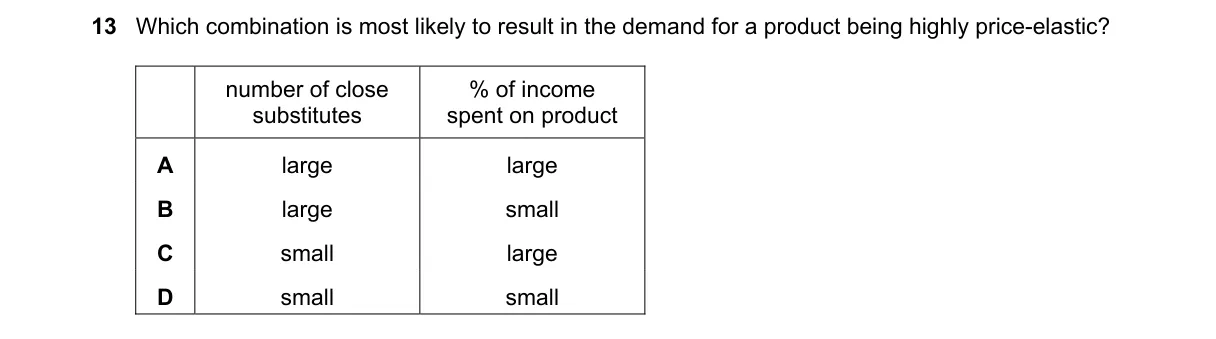
Answer choices
- Alarge number of close substitutes, large % of income spent on product
- Blarge number of close substitutes, small % of income spent on product
- Csmall number of close substitutes, large % of income spent on product
- Dsmall number of close substitutes, small % of income spent on product
Explanation
Price Elasticity of Demand Determinants
Steps:
- Recall that price elasticity measures responsiveness of quantity demanded to price changes; elastic demand (>1) occurs with easy alternatives or high budget impact.
- Identify key factors: many close substitutes make switching easy, increasing elasticity; large income share amplifies price sensitivity.
- Evaluate choices: A combines both factors for maximum elasticity; B has substitutes but low income impact, reducing overall elasticity; C lacks substitutes despite high income share; D has neither.
- Conclude A yields highest elasticity.
Why A is correct:
- Law of demand states elasticity rises with abundant substitutes (consumers switch easily) and high income proportion (price hikes strain budgets more), per elasticity formula |%ΔQd / %ΔP| >1.
Why the others are wrong:
- B: Substitutes promote elasticity, but small income share limits sensitivity, leading to inelastic demand.
- C: Large income share increases sensitivity, but few substitutes trap consumers, causing inelasticity.
- D: Both factors (few substitutes, small income share) result in highly inelastic demand.
Final answer: A
Topic: Price elasticity, income elasticity and cross elasticity of demand
Practice more A Level Economics (9708) questions on mMCQ.me