A Level Economics (9708)•9708/12/M/J/20
A Level Economics (9708) — 9708/12/M/J/20, Question 24
The diagram shows an economy at full employment equilibrium. Which short-run measure should the government take to maintain the economy's current equilibrium if there is an unexpected balance of trade surplus?
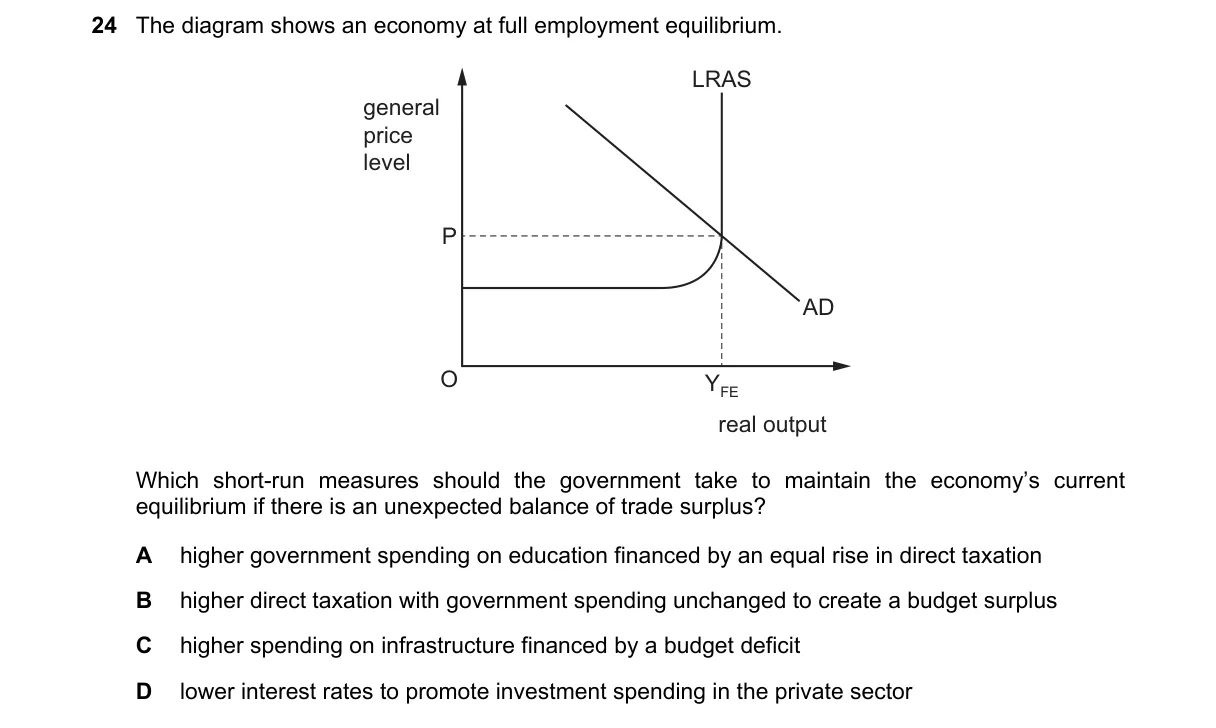
Answer choices
- AHigher government spending on education financed by an equal rise in direct taxation
- BHigher direct taxation with government spending unchanged to create a budget surplus
- CLower interest rates to promote investment spending in the private sector
- DHigher interest rates to reduce investment spending in the private sector
Explanation
Counteracting Expansionary Trade Surplus at Full Employment
Steps:
- A trade surplus increases net exports, shifting AD rightward and risking inflation at full employment.
- To maintain equilibrium, apply contractionary fiscal policy to offset the AD increase.
- Higher direct taxation with unchanged spending reduces disposable income and consumption.
- This creates a budget surplus, stabilizing output and prices without overheating.
Why B is correct:
- Budget surplus withdraws money from circulation (G - T < 0), reducing aggregate demand per Keynesian fiscal policy to neutralize the surplus's expansionary effect.
Why the others are wrong:
- A: Balanced budget multiplier is zero, so AD remains unchanged and fails to offset the surplus.
- C: Lower interest rates boost investment, expanding AD further and exacerbating inflation.
- D: Higher interest rates curb investment but represent monetary policy, not directly addressing the fiscal imbalance from the surplus.
Final answer: B
Topic: Policies to correct imbalances in the current account of the balance of payments
Practice more A Level Economics (9708) questions on mMCQ.me