A Level Economics (9708)•9708/11/M/J/20
A Level Economics (9708) — 9708/11/M/J/20, Question 20
The diagram shows the aggregate demand (AD) and aggregate supply (AS) curves for an economy. Which situation would not cause a shift from AD0 to AD1?
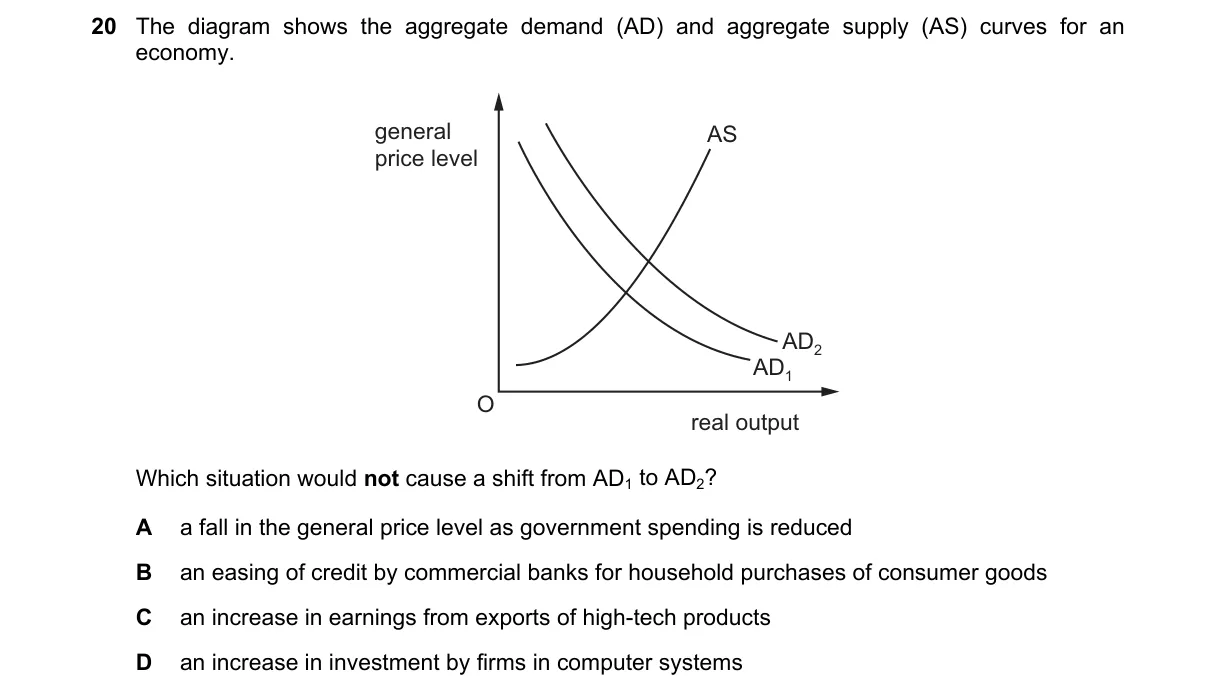
Answer choices
- Aa fall in the general price level
- Ban easing of credit by commercial banks for household purchases of consumer goods
- Can increase in earnings from exports of high-tech products
- Dan increase in investment by firms in computer systems
Explanation
Aggregate Demand Shifts vs. Movements
Steps:
- AD curve plots real output demanded at various price levels; shifts occur from changes in C, I, G, or NX.
- Price level changes cause movements along the existing AD curve, not shifts.
- Options B, C, D affect AD components, shifting AD rightward to AD1.
- Option A only moves along AD0, so it does not cause the shift.
Why A is correct:
- A fall in price level increases quantity demanded via the wealth effect, causing a movement down along AD0, per the AD definition.
Why the others are wrong:
- B increases consumer spending (C) through easier credit, shifting AD right.
- C boosts net exports (NX) via higher export earnings, shifting AD right.
- D raises investment (I) in capital, shifting AD right.
Final answer: A
Topic: Aggregate Demand and Aggregate Supply analysis
Practice more A Level Economics (9708) questions on mMCQ.me