A Level Economics (9708)•9708/13/M/J/19
A Level Economics (9708) — 9708/13/M/J/19, Question 20
A country devalues its currency in the expectation that a deficit on the current account of the balance of payments will reduce. What is necessary to make happen?
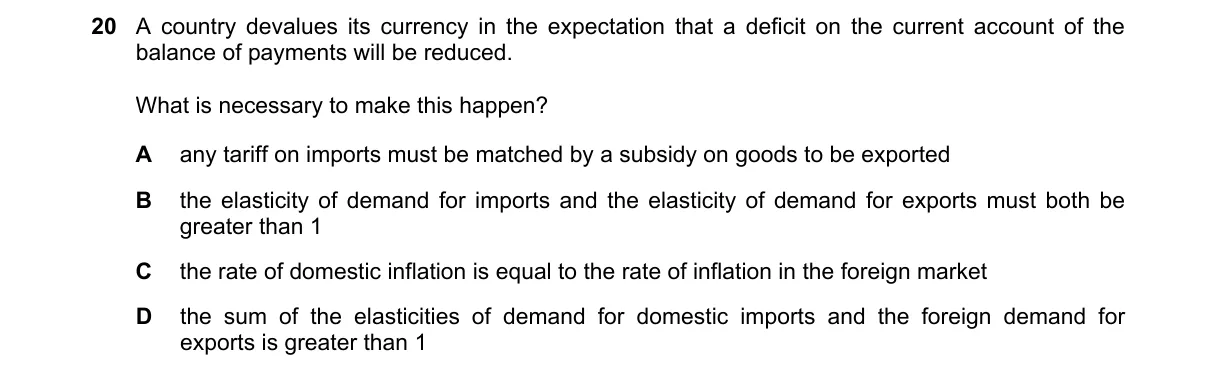
Answer choices
- Aany tariff on imports must be matched by a subsidy on goods to be exported
- Bthe elasticity of demand for imports and the elasticity of demand for exports must both be greater than 1
- Cthe sum of the elasticities of demand for imports and exports is greater than 1
- Dthe rate of domestic inflation is greater than the rate of inflation in the foreign market for exports
Explanation
Marshall-Lerner Condition for Devaluation Success
Steps:
- Devaluation lowers export prices abroad and raises import prices domestically, aiming to boost exports and cut imports.
- For net export volume to rise and improve the current account, quantity responses must outweigh price effects.
- This requires elastic demand: export demand elasticity (ηx) measures foreign response to cheaper exports; import demand elasticity (ηm) measures domestic response to costlier imports.
- The trade balance improves if ηx + ηm > 1, per the Marshall-Lerner condition.
Why C is correct:
- The Marshall-Lerner condition states that devaluation improves the trade balance only if the sum of export and import demand elasticities exceeds 1, ensuring volume gains exceed value losses.
Why the others are wrong:
- A: Tariffs and subsidies are trade policies unrelated to devaluation's direct price elasticity effects.
- B: Both elasticities >1 is sufficient but not necessary; the sum >1 allows one to be <1 if the other compensates.
- D: Higher domestic inflation erodes devaluation benefits over time but is not required for the initial current account improvement.
Final answer: C
Topic: Policies to correct imbalances in the current account of the balance of payments
Practice more A Level Economics (9708) questions on mMCQ.me