A Level Economics (9708)•9708/13/M/J/19
A Level Economics (9708) — 9708/13/M/J/19, Question 11
The diagram shows the demand and supply curves of a normal good X. Q1 is the initial equilibrium. Other things equal, what may cause the change in the market equilibrium Q1?
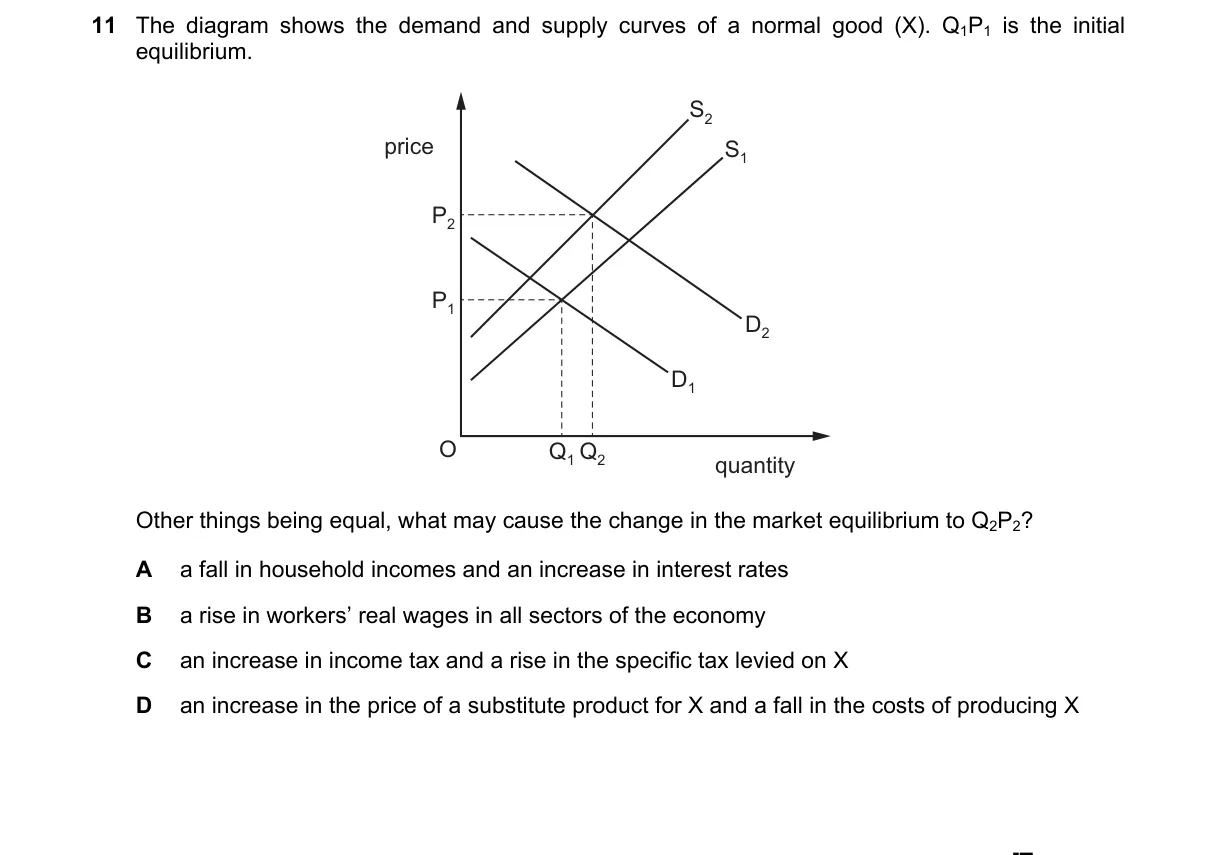
Answer choices
- Aa fall in household incomes and an increase in the interest rates
- Ba rise in workers' real wages in all sectors of the economy
- Can increase in the price of a substitute product and a fall in the costs of producing X
- Dan increase in the price of a substitute product X and a fall in the costs of producing X
Explanation
Economy-wide wage rise shifts supply left, changing equilibrium quantity
Steps:
- Examine each option for impacts on demand (income, substitutes) and supply (costs, wages).
- Rising real wages raise production costs across sectors, shifting supply curve leftward.
- Leftward supply shift raises price and lowers equilibrium quantity from Q1.
- Compare to diagram: this matches the observed change in Q1.
Why B is correct:
- Per the law of supply, higher input costs (wages) decrease quantity supplied at each price, shifting supply left and reducing equilibrium Q.
Why the others are wrong:
- A: Fall in incomes shifts demand left (lowers Q); higher interest rates shift supply left (lowers Q)—causes Q decrease but via demand shift, not pure supply.
- C: Higher substitute price shifts demand right (raises Q); lower production costs shift supply right (raises Q)—increases Q, opposite of diagram.
- D: Higher substitute price shifts demand right (raises Q); lower production costs shift supply right (raises Q)—increases Q, opposite of diagram.
Final answer: B
Topic: The interaction of demand and supply
Practice more A Level Economics (9708) questions on mMCQ.me