A Level Economics (9708)•9708/12/M/J/19
A Level Economics (9708) — 9708/12/M/J/19, Question 8
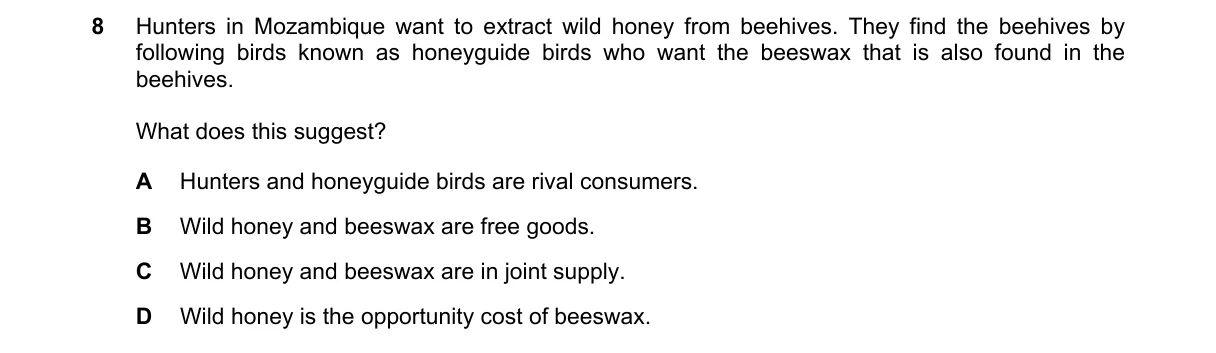
Hunters in Mozambique want to extract wild honey from beehives. They find the beehives by following birds known as honeyguide birds who want the beeswax that is also found in the beehives. What does this suggest?
Answer choices
- AHunters and honeyguide birds are rival consumers.
- BWild honey and beeswax are free goods.
- CWild honey and beeswax are in joint supply.
- DWild honey is the opportunity cost of beeswax.
Explanation
Joint Supply in Beehives
Steps:
- Beehives produce both honey and beeswax simultaneously from the same resource.
- Hunters extract honey, while birds seek beeswax from the same hive.
- The mutual benefit shows the goods are obtained together without separate production.
- This indicates the products are in joint supply, as supply of one affects the other.
Why C is correct:
- Joint supply occurs when two or more goods are produced together from the same process, so increasing supply of one increases the other, as defined in economics.
Why the others are wrong:
- A: Hunters and birds cooperate, not compete as rivals.
- B: Extraction requires effort, so honey and beeswax are not free goods with zero cost.
- D: Honey and beeswax are jointly produced, not one the opportunity cost of the other.
Final answer: C
Topic: Classification of goods and services
Practice more A Level Economics (9708) questions on mMCQ.me