A Level Economics (9708)•9708/12/M/J/19
A Level Economics (9708) — 9708/12/M/J/19, Question 4
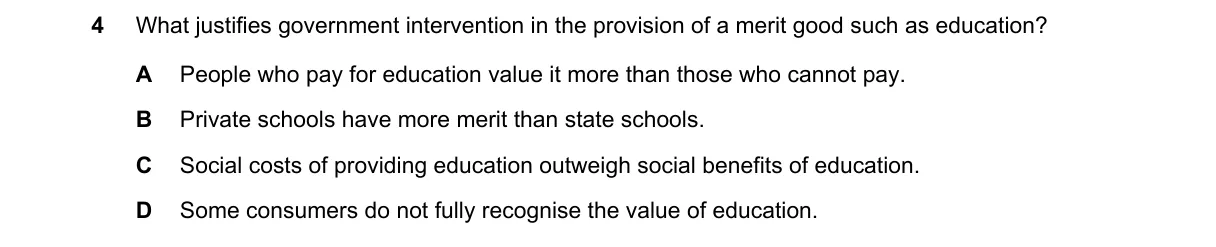
What justifies government intervention in the provision of a merit good such as education?
Answer choices
- APeople who pay for education value it more than those who cannot pay.
- BPrivate schools have more merit than state schools.
- CSocial costs of providing education outweigh social benefits of education.
- DSome consumers do not fully recognise the value of education.
Explanation
Merit Goods and Information Failure
Steps:
- Identify merit goods as items with positive externalities where social benefits exceed private benefits.
- Recognize that consumers undervalue merit goods due to imperfect information, leading to underconsumption.
- Apply to education: individuals may not fully appreciate long-term benefits like higher earnings or societal gains.
- Conclude government intervenes via subsidies or provision to correct underprovision and maximize social welfare.
Why D is correct:
- Merit goods definition includes information failure, where consumers underestimate benefits, justifying intervention to ensure optimal consumption.
Why the others are wrong:
- A: Focuses on affordability, not the inherent undervaluation central to merit goods.
- B: Irrelevant comparison of school types; intervention targets market failure, not quality differences.
- C: Incorrect, as merit goods have social benefits exceeding costs, prompting intervention.
Final answer: D
Topic: Reasons for government intervention in markets
Practice more A Level Economics (9708) questions on mMCQ.me