A Level Economics (9708)•9708/12/M/J/19
A Level Economics (9708) — 9708/12/M/J/19, Question 28
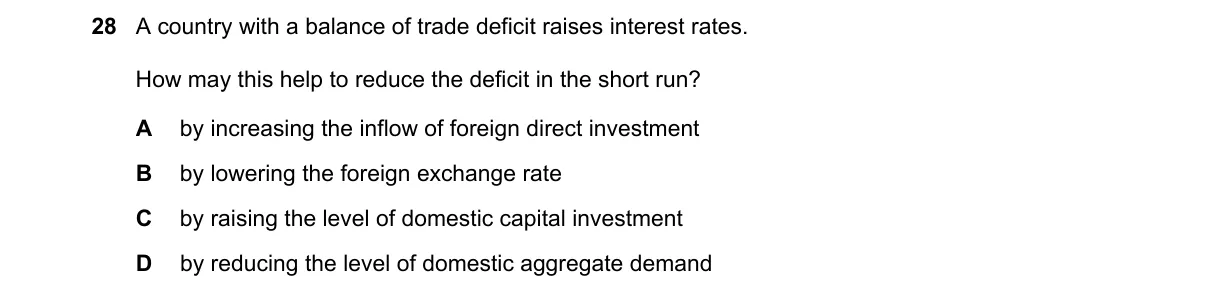
A country with a balance of trade deficit raises interest rates. How might this help reduce the deficit in the short run?
Answer choices
- Aby increasing the inflow of foreign direct investment
- Bby lowering the flow of foreign direct investment
- Cby raising the level of domestic capital investment
- Dby reducing the level of domestic aggregate demand
Explanation
Higher interest rates curb imports via reduced demand
Steps:
- Raising interest rates increases borrowing costs for households and firms.
- Higher costs reduce spending on consumption and investment.
- Lower domestic aggregate demand decreases demand for imported goods.
- Fewer imports improve net exports, reducing the trade deficit.
Why D is correct:
- In the trade balance formula (exports - imports), reduced aggregate demand directly lowers imports by curbing overall spending, per Keynesian economics.
Why the others are wrong:
- A: Higher rates attract foreign capital inflows, worsening the current account deficit via currency appreciation that hurts exports.
- B: Higher rates boost, not lower, foreign direct investment inflows seeking better returns.
- C: Higher rates raise borrowing costs, discouraging domestic capital investment.
Final answer: D
Topic: Policies to correct imbalances in the current account of the balance of payments
Practice more A Level Economics (9708) questions on mMCQ.me