A Level Economics (9708)•9708/12/M/J/19
A Level Economics (9708) — 9708/12/M/J/19, Question 27
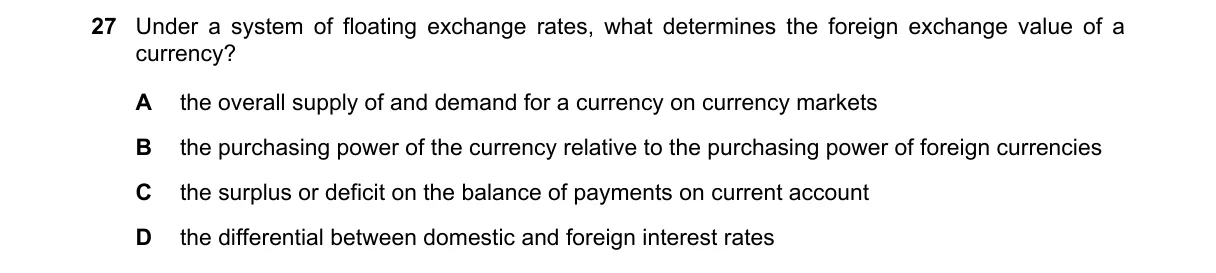
Under a system of floating exchange rates, what determines the foreign exchange value of a currency?
Answer choices
- Athe overall supply of and demand for a currency on currency markets
- Bthe purchasing power of currency relative to the purchasing power
- Cthe surplus or deficit balance payments on current account of foreign currencies
- Dthe differential between domestic and foreign interest rates
Explanation
Supply and Demand Determines Currency Value in Floating Rates
Steps:
- Recall that floating exchange rates are market-driven, not fixed by governments.
- Identify that currency value is set where supply equals demand in forex markets.
- Eliminate options tied to fixed-rate factors like government intervention or balances.
- Confirm A matches the core economic principle of flexible rates.
Why A is correct:
- In floating systems, exchange rates are determined by the equilibrium of supply (from exports, capital outflows) and demand (from imports, capital inflows) per basic market forces in international economics.
Why the others are wrong:
- B: Purchasing power parity influences long-term rates but doesn't directly set short-term market values.
- C: Current account balances affect supply/demand indirectly but aren't the direct determinant.
- D: Interest rate differentials influence capital flows and thus demand, but the ultimate value comes from overall market supply and demand.
Final answer: A
Topic: Exchange rates
Practice more A Level Economics (9708) questions on mMCQ.me