A Level Economics (9708)•9708/12/M/J/19
A Level Economics (9708) — 9708/12/M/J/19, Question 23
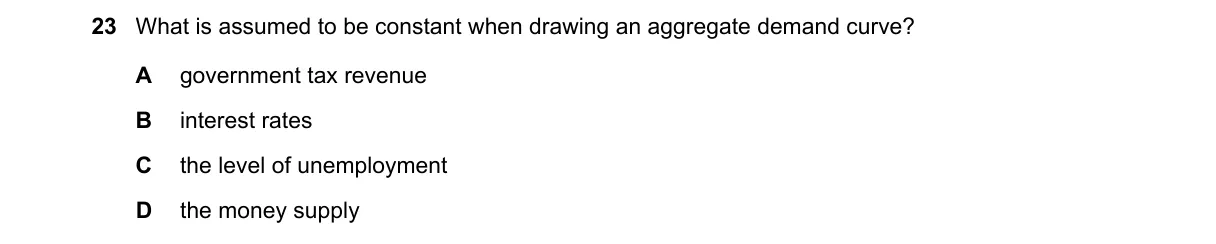
What is assumed to be constant when drawing aggregate demand curve
Answer choices
- Agovernment tax revenue
- Binterest rates
- Cthe level of unemployment
- Dthe money supply
Explanation
Ceteris Paribus in Aggregate Demand Curve
Steps:
- Define aggregate demand (AD) as total spending on goods and services at different price levels.
- Note that the AD curve slopes downward due to wealth, interest rate, and exchange rate effects.
- Identify ceteris paribus: factors like money supply, fiscal policy, and expectations are held constant to isolate price level's impact.
- Confirm money supply is fixed, as its changes shift the entire AD curve.
Why D is correct:
- The AD curve assumes constant money supply per the quantity theory of money (MV = PY), where fixed M isolates price level (P) effects on real output (Y).
Why the others are wrong:
- A: Government tax revenue is fiscal policy; changes shift AD, not held constant.
- B: Interest rates vary along the curve as higher prices raise money demand, increasing rates.
- C: Unemployment level is a macroeconomic outcome affected by AD shifts, not assumed constant.
Final answer: D
Topic: Aggregate Demand and Aggregate Supply analysis
Practice more A Level Economics (9708) questions on mMCQ.me