A Level Economics (9708)•9708/12/M/J/19
A Level Economics (9708) — 9708/12/M/J/19, Question 16
Government intends to introduce a minimum price for rice, a maximum price for heating oil and a tax on chewing gum. Who, in each market, is meant to benefit from these policies?
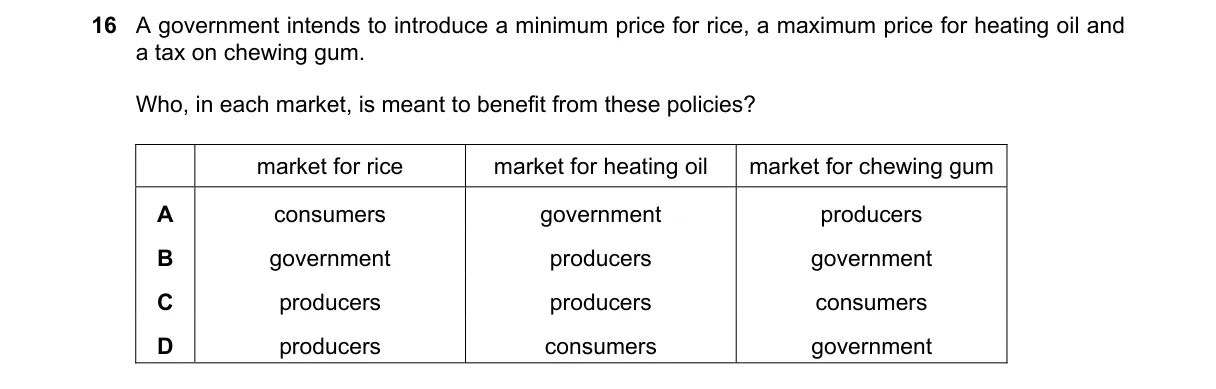
Answer choices
- Amarket for rice: consumers; market for heating oil: producers; market for chewing gum: producers
- Bmarket for rice: government; market for heating oil: producers; market for chewing gum: government
- Cmarket for rice: government; market for heating oil: producers; market for chewing gum: government
- Dmarket for rice: producers; market for heating oil: consumers; market for chewing gum: government
Explanation
Government price controls and taxes benefit specific groups
Steps:
- Identify minimum price (price floor) for rice: sets price above equilibrium to support producers.
- Identify maximum price (price ceiling) for heating oil: sets price below equilibrium to aid consumers.
- Identify tax on chewing gum: imposes levy collected by government for revenue.
- Match benefits: producers gain from higher rice prices, consumers from lower oil prices, government from gum tax.
Why D is correct:
- Price floors raise producer revenue (P > equilibrium), ceilings lower consumer costs (P < equilibrium), and taxes generate government fiscal surplus per unit sold.
Why the others are wrong:
- A: Wrongly assigns rice benefit to consumers (floors harm them) and gum to producers (tax burdens sellers/buyers, not them directly).
- B/C: Wrongly assign rice benefit to government (floors aid producers, not fiscal policy).
Final answer: D
Topic: Methods and effects of government intervention in markets
Practice more A Level Economics (9708) questions on mMCQ.me