A Level Economics (9708)•9708/11/M/J/19
A Level Economics (9708) — 9708/11/M/J/19, Question 30
A country with low unemployment and a managed floating exchange rate has persistent current account deficit on its balance of payments. Which policy to reduce this is likely to keep unemployment low, but cause inflation?
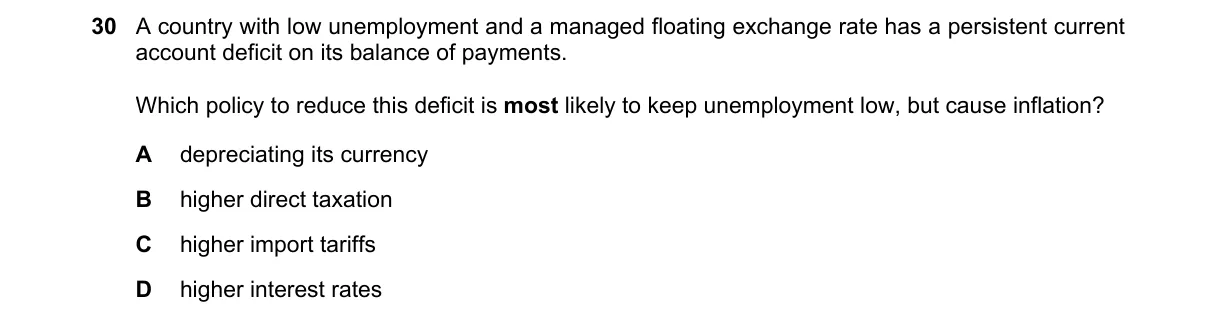
Answer choices
- ADepreciating its currency
- Bhigher direct taxation
- Chigher import tariffs
- Dhigher interest rates
Explanation
Currency Depreciation Improves Trade Balance at Full Employment
Steps:
- Persistent current account deficit requires boosting exports or curbing imports to improve balance of payments.
- Low unemployment means economy is near full capacity, so expansionary policies risk inflation without much employment gain.
- Managed floating exchange rate allows government intervention to depreciate currency, enhancing competitiveness.
- Evaluate policies: seek one that expands net exports without contracting demand, preserving low unemployment but raising prices.
Why A is correct:
- Depreciation lowers export prices and raises import prices, increasing net exports per the Marshall-Lerner condition, boosting aggregate demand and causing inflation at full employment without raising unemployment.
Why the others are wrong:
- B: Higher direct taxation reduces disposable income and aggregate demand, likely increasing unemployment.
- C: Higher import tariffs protect domestic firms but raise consumer prices without directly expanding output, potentially causing inefficiencies without addressing unemployment.
- D: Higher interest rates attract capital inflows, appreciating the currency and worsening the deficit while contracting demand, risking higher unemployment.
Final answer: A
Topic: Policies to correct imbalances in the current account of the balance of payments
Practice more A Level Economics (9708) questions on mMCQ.me