A Level Economics (9708)•9708/11/M/J/19
A Level Economics (9708) — 9708/11/M/J/19, Question 23
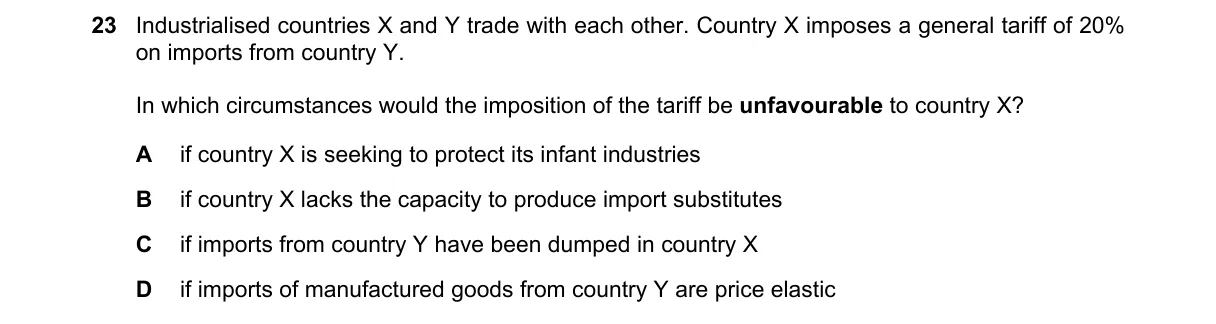
Industrialised countries X and Y trade with each other. Country X imposes a general tariff of 20% on imports from country Y. In which circumstances would the imposition of the tariff be unfavourable to country X
Answer choices
- AIf country X is seeking to protect its infant industries
- BIf country X lacks the capacity to produce import substitutes
- CIf imports manufactured goods from country Y are price elastic
- DIf imports from country Y have been dumped in country X
Explanation
Tariffs Fail Without Domestic Substitutes
Steps:
- Tariffs raise import prices to protect domestic production and generate revenue.
- They benefit X if domestic industries can substitute imports, reducing reliance on Y.
- Without substitute capacity, tariffs increase costs for consumers and firms without boosting local output.
- Evaluate options: unfavorable when protection yields no supply response.
Why B is correct:
- Lacking capacity means no domestic production increase, causing deadweight loss from higher prices without welfare gains (per standard tariff analysis).
Why the others are wrong:
- A: Protects infant industries by shielding them from competition, aiding growth.
- C: Elastic demand amplifies import reduction, aligning with tariff goals to curb foreign reliance.
- D: Counters dumping (sales below cost), restoring fair competition and benefiting X's producers.
Final answer: B
Topic: Protectionism
Practice more A Level Economics (9708) questions on mMCQ.me