A Level Economics (9708)•9708/13/M/J/18
A Level Economics (9708) — 9708/13/M/J/18, Question 7
If the rectangle LMN is equal to the area in the rectangle OPQR, which statement is correct?
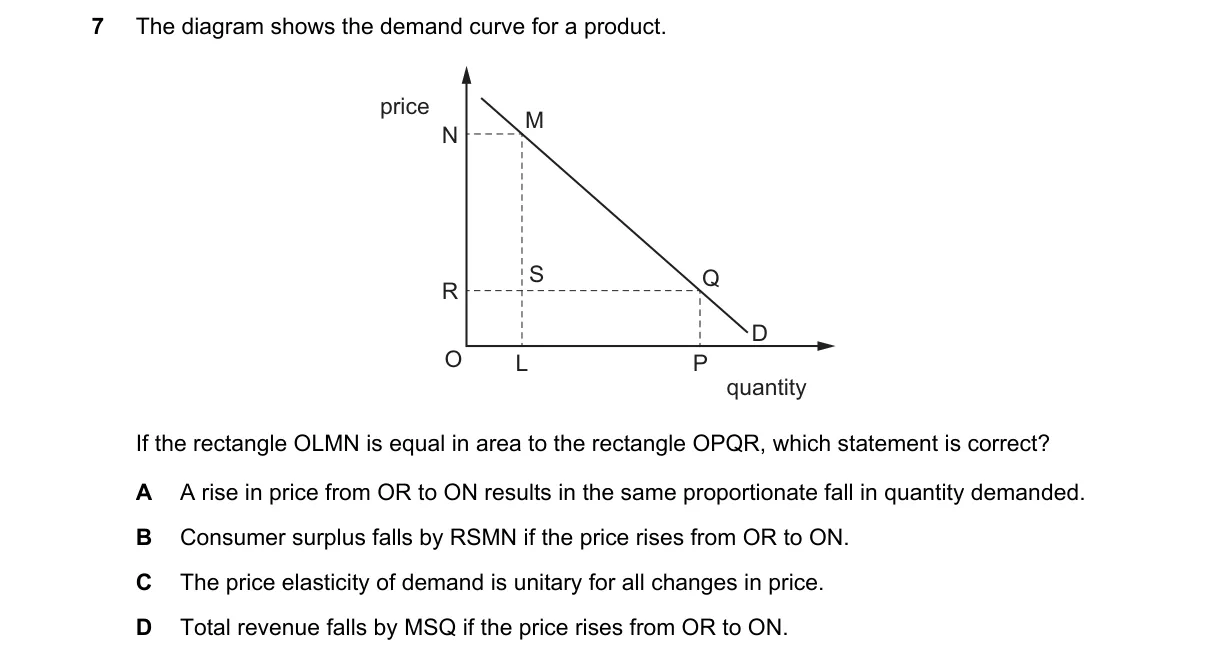
Answer choices
- AConsumer surplus falls by RS MN if the price rises from OR to ON.
- BTotal revenue falls by MSO if the price rises from OR to ON.
- CThe price elasticity of demand is unitary for changes in price from OR to ON.
- DProducer surplus rises by RS MN if the price rises from OR to ON.
Explanation
Equal Revenue Areas Imply Unchanged Total Revenue and Surplus Shifts
Steps:
- Rectangle OPQR is initial total revenue (price OR × quantity at OR).
- Rectangle LMN is new total revenue (price ON × quantity at ON), equal area means total revenue constant.
- Price rise from OR to ON reduces quantity, shifting consumer surplus downward.
- Consumer surplus falls by trapezoid RS MN (rectangle part + triangle under demand curve to new quantity).
Why A is correct:
- By definition, consumer surplus change equals area between demand curve and price levels from new to original quantity, labeled RS MN here.
Why the others are wrong:
- B: Total revenue unchanged (equal areas), so does not fall by MSO.
- C: Equal revenues imply unitary arc elasticity, but statement specifies "for changes," which misstates point vs. arc elasticity.
- D: Producer surplus rises only by rectangle (ON - OR) × new quantity, not full RS MN (excludes deadweight loss triangle).
Final answer: A
Topic: Consumer and producer surplus
Practice more A Level Economics (9708) questions on mMCQ.me