A Level Economics (9708)•9708/13/M/J/18
A Level Economics (9708) — 9708/13/M/J/18, Question 30
Bulgaria's Consumer Price Index fell at an annual rate of -2% in April. In May the annual rate of change was -1.4%. What fiscal and monetary policy would be most appropriate in the short run to restore price stability?
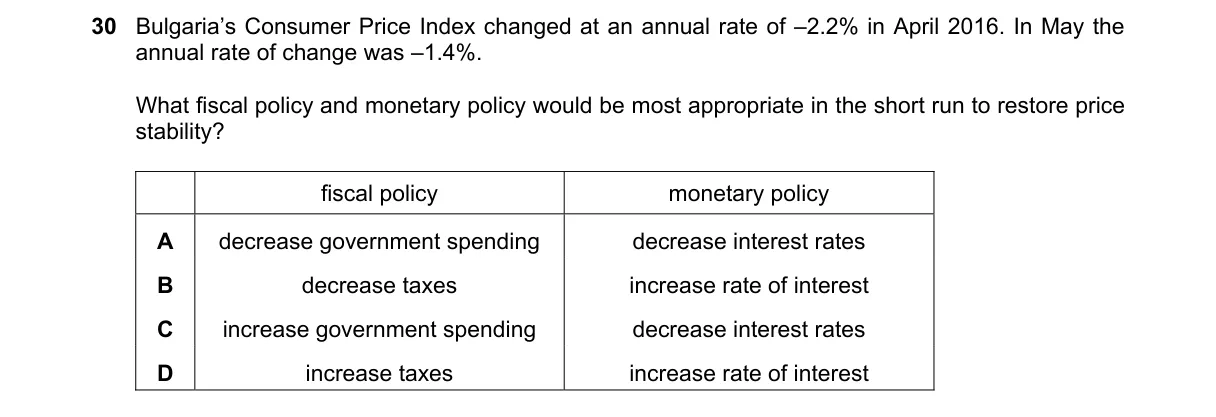
Answer choices
- Adecrease government spending, decrease interest rates
- Bdecrease taxes, increase interest rates
- Cincrease government spending, increase interest rates
- Dincrease taxes, increase interest rates
Explanation
Combating deflation with expansionary fiscal policy Steps:
- Negative CPI rates (-2% to -1.4%) signal deflation from weak aggregate demand.
- Price stability requires shifting aggregate demand rightward to raise prices toward zero or target inflation.
- Expansionary fiscal policy increases government spending to boost output and prices via multiplier effect.
- Contractionary monetary policy (higher rates) supports currency peg stability in Bulgaria's fixed exchange rate system, preventing capital outflows.
Why C is correct:
- Increasing government spending expands AD per Keynesian multiplier (ΔY = k * ΔG, where k > 1), countering deflation; higher rates maintain lev-euro peg under currency board rules.
Why the others are wrong:
- A: Decreasing spending contracts AD, worsening deflation.
- B: Increasing rates tightens money supply, but decreasing taxes alone may not offset without direct spending boost.
- D: Both policies contract AD, deepening deflation.
Final answer: C
Topic: Government macroeconomic policy objectives
Practice more A Level Economics (9708) questions on mMCQ.me