A Level Economics (9708)•9708/13/M/J/18
A Level Economics (9708) — 9708/13/M/J/18, Question 27
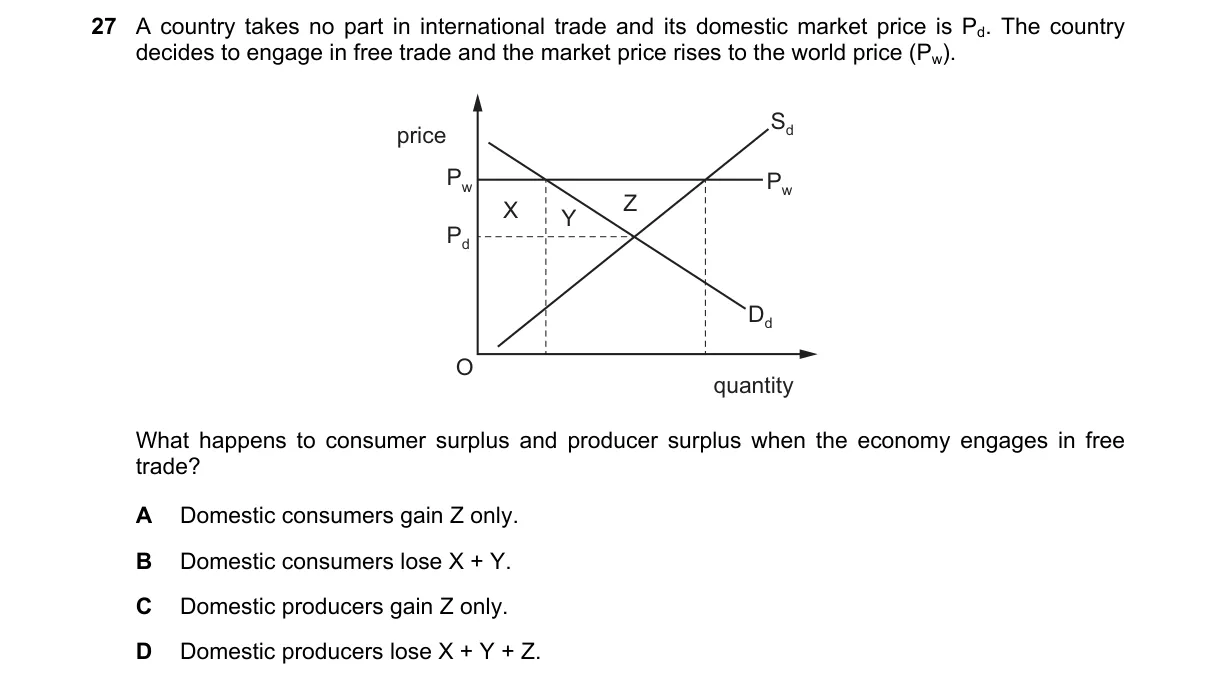
A country takes no part in international trade and its domestic market price is P_d. The country decides to engage in free trade and the market price rises to the world price P_w. What happens to consumer surplus and producer surplus when the economy engages in free trade?
Answer choices
- ADomestic consumers gain X+Y.
- BDomestic consumers lose X+Y.
- CDomestic producers gain Z+Y.
- DDomestic producers lose X+Y+Z.
Explanation
Free Trade Raises Domestic Price, Hurting Consumers
Steps:
- Autarky price P_d sets initial consumer surplus (area above P_d to demand curve) and producer surplus (below P_d to supply curve).
- Free trade sets price at P_w > P_d, so quantity demanded falls as consumers pay more.
- Consumer surplus loss is the area between P_d and P_w under the demand curve, labeled X+Y.
- Producer surplus gain is the area between P_d and P_w above the supply curve, labeled Y+Z.
Why B is correct:
- Consumer surplus decreases by X+Y, the rectangular and triangular losses from higher price reducing quantity and willingness to pay.
Why the others are wrong:
- A: Consumers lose surplus at higher price, do not gain.
- C: Producers gain Y+Z, not Z+Y (mislabels gain areas).
- D: Producers gain from higher price, do not lose.
Final answer: B
Topic: The reasons for international trade
Practice more A Level Economics (9708) questions on mMCQ.me