A Level Economics (9708)•9708/13/M/J/18
A Level Economics (9708) — 9708/13/M/J/18, Question 25
A particular good in the Barbados market could be supplied by domestic producers, or producers in Trinidad and Tobago, or producers in the United States (US), at the prices shown in US dollars. Originally, Barbados had a 20% ad valorem duty on imports from Trinidad and Tobago and the US. Also Barbados formed a customs union with Trinidad and Tobago, with a common external tariff of 20% on imports from the US, after the formation of the customs union. From which countries would Barbados import the good, before and after the formation of the customs union?
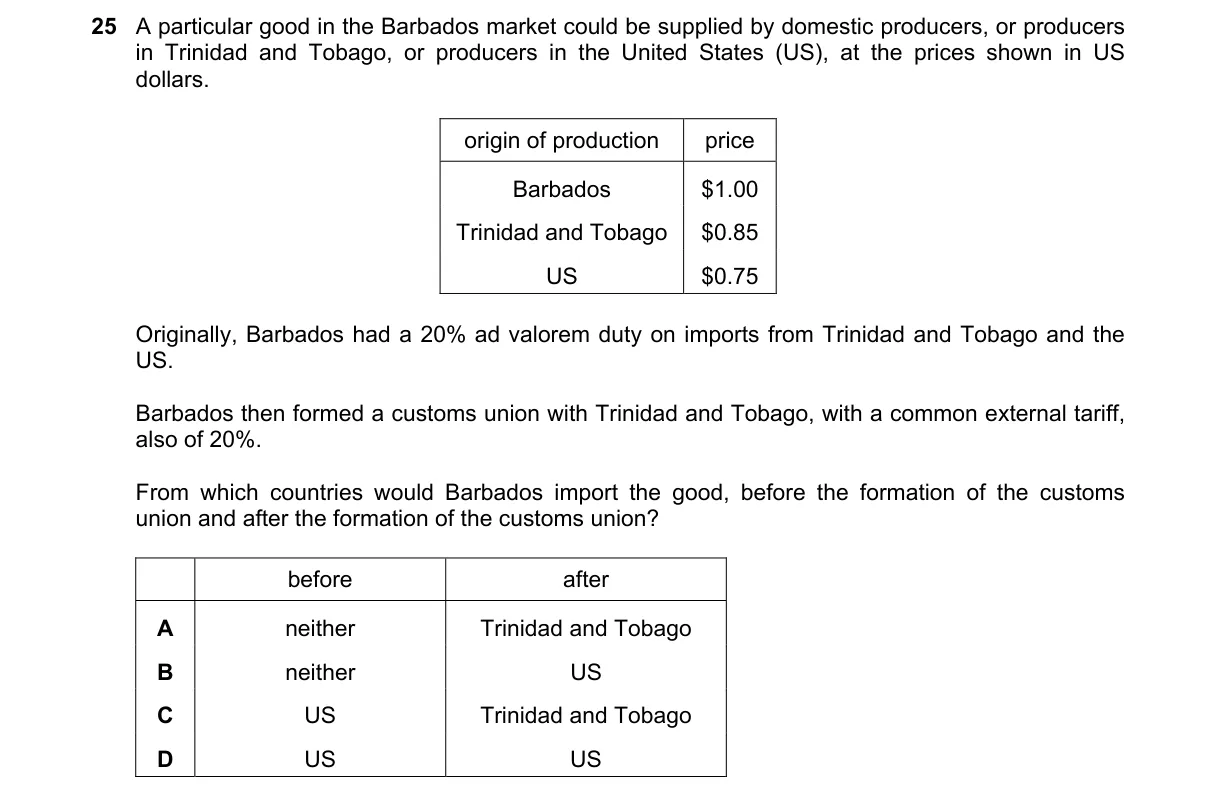
Answer choices
- Abefore: neither; after: Trinidad and Tobago
- Bbefore: neither; after: US
- Cbefore: US; after: Trinidad and Tobago
- Dbefore: US; after: Trinidad and US
Explanation
Customs Union Trade Creation Steps:
- Calculate pre-union effective prices: add 20% tariff to T&T and US prices; Barbados imports from lowest effective price source (US, assuming its base price is lowest).
- Post-union: T&T imports duty-free (effective price = base price); US still faces 20% tariff; Barbados imports from T&T if its base price < US tariffed price and < domestic price.
- Compare: pre-union, US effective price < T&T effective price, so import US; post-union, T&T base price < US effective price, so switch to T&T.
- Result: imports shift from US to T&T due to duty elimination on intra-union trade.
Why C is correct:
- Customs union eliminates internal tariffs, creating trade by favoring lower-cost partner (T&T) over tariffed external source (US), per Viner's trade creation effect.
Why the others are wrong:
- A: Pre-union imports occur from US (lowest tariffed price), not neither.
- B: Post-union favors duty-free T&T over US, not US.
- D: Post-union imports only from T&T (duty-free cheapest), not both.
Final answer: C
Topic: Protectionism
Practice more A Level Economics (9708) questions on mMCQ.me