A Level Economics (9708)•9708/13/M/J/18
A Level Economics (9708) — 9708/13/M/J/18, Question 14
The demand and supply functions for a product are quantity demanded = 500 - P and quantity supplied = 300P where P = price. With government regulation, the current price in the market is $5. What can be said about the form of price regulation and the balance of demand and supply in the market?
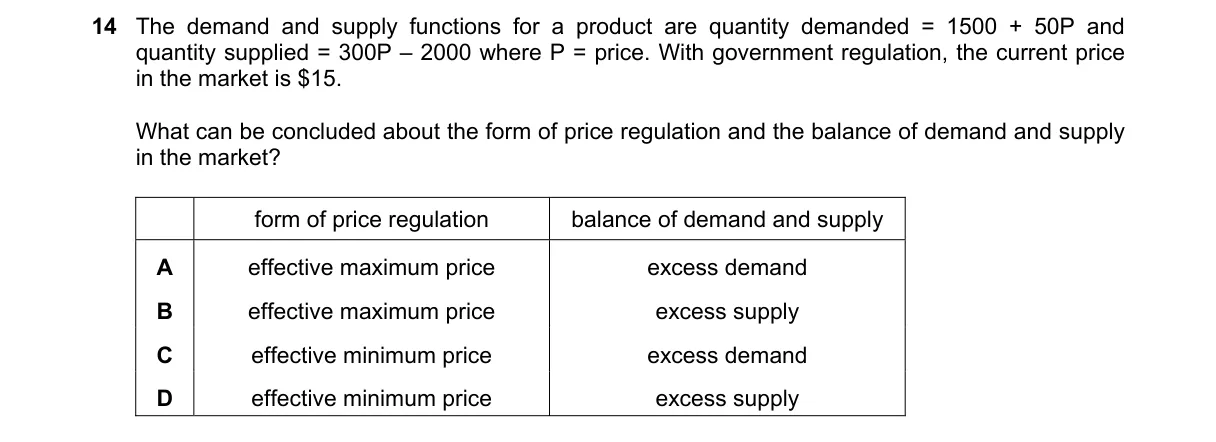
Answer choices
- Aeffective maximum price excess demand
- Beffective minimum price excess supply
- Ceffective minimum price excess demand
- Deffective minimum price excess supply
Explanation
Price floor creates excess supply at $5
Steps:
- Set demand equal to supply: 500 - P = 300P → P = 500/301 ≈ $1.66 (equilibrium price).
- At P = $5 (> equilibrium), calculate quantity demanded: 500 - 5 = 495 units.
- Calculate quantity supplied: 300 × 5 = 1,500 units.
- Compare: supplied (1,500) > demanded (495), so excess supply; regulation is a binding minimum price.
Why D is correct:
- A price floor above equilibrium restricts quantity sold to demand (495) but incentivizes excess production (1,500), creating surplus per supply-demand law.
Why the others are wrong:
- A: Maximum price (ceiling) below equilibrium causes excess demand, not supply.
- B: Minimum price causes excess supply, but B says excess demand (incorrect mismatch).
- C: Minimum price causes excess supply, not demand.
Final answer: D
Topic: Methods and effects of government intervention in markets
Practice more A Level Economics (9708) questions on mMCQ.me