A Level Economics (9708)•9708/13/M/J/18
A Level Economics (9708) — 9708/13/M/J/18, Question 11
In which set of circumstances will play no role in determining how resources are allocated between alternative uses but may still have a role as a rationing mechanism?
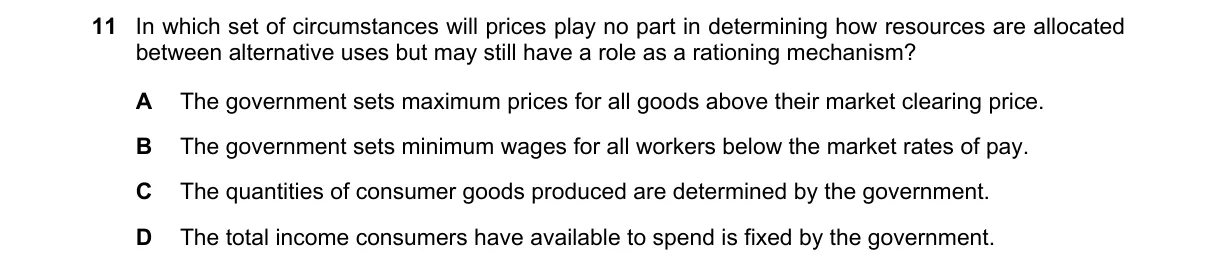
Answer choices
- AThe government sets maximum prices for all goods above their market clearing price.
- BThe quantities of consumer goods produced are determined by the government.
- CThe government sets minimum wages for all workers below their market rates.
- DThe total income consumers have available to spend is fixed by the government.
Explanation
Prices as Non-Allocation but Rationing Device in Wage Floors
Steps:
- Identify the question: Scenarios where prices do not guide resource allocation (e.g., via supply/demand) but still ration scarce goods/services.
- Recall market role: Prices allocate resources by signaling scarcity and directing production/consumption; rationing occurs when prices limit access.
- Evaluate choices: Check if government intervention overrides price signals for allocation while retaining rationing (e.g., queues or limits).
- Select best fit: Minimum wages below market distort labor allocation but use wage thresholds to ration jobs.
Why C is correct:
- Minimum wages below market rates prevent prices (wages) from equating labor supply/demand, so allocation shifts to non-price factors (e.g., favoritism); wages still ration jobs by excluding lower bidders, per labor economics definition of binding floors.
Why the others are wrong:
- A: Maximum prices above equilibrium allow market prices to allocate resources normally, not overriding them.
- B: Government production quotas eliminate price signals entirely for both allocation and rationing.
- D: Fixed incomes alter effective demand but prices still allocate via relative purchasing power.
Final answer: C