A Level Economics (9708)•9708/12/M/J/18
A Level Economics (9708) — 9708/12/M/J/18, Question 6
The diagram shows the demand curve for a product. Which statement is correct?
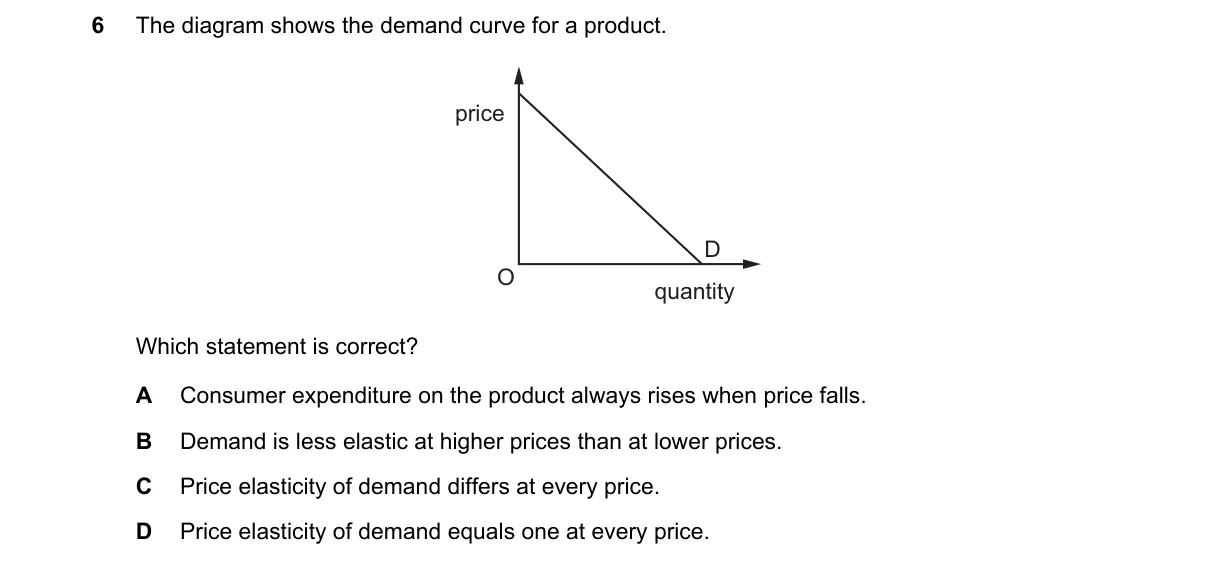
Answer choices
- AConsumer expenditure on the product always rises when price falls.
- BDemand is less elastic at higher prices than at lower prices.
- CPrice elasticity of demand differs at every price.
- DPrice elasticity of demand equals one at every price.
Explanation
Price Elasticity Varies Along a Linear Demand Curve
Steps:
- Identify the demand curve as linear and downward-sloping, typical in such diagrams.
- Apply the price elasticity formula: PED = (% change in quantity demanded) / (% change in price).
- Note that for linear curves, PED exceeds 1 above the midpoint (elastic), equals 1 at midpoint, and is below 1 below (inelastic).
- Conclude PED changes continuously with price and quantity.
Why C is correct:
- PED differs at every price on a linear demand curve because the formula PED = (dQ/dP) * (P/Q) varies as P and Q change along the curve.
Why the others are wrong:
- A: Expenditure rises with falling price only if elastic; it falls if inelastic, per total revenue = P * Q.
- B: Linear demand is more elastic at higher prices (larger %ΔQ for %ΔP) than at lower prices.
- D: PED equals one only at the midpoint where MR=0, not at every price.
Final answer: C
Topic: Price elasticity, income elasticity and cross elasticity of demand
Practice more A Level Economics (9708) questions on mMCQ.me