A Level Economics (9708)•9708/12/M/J/18
A Level Economics (9708) — 9708/12/M/J/18, Question 29
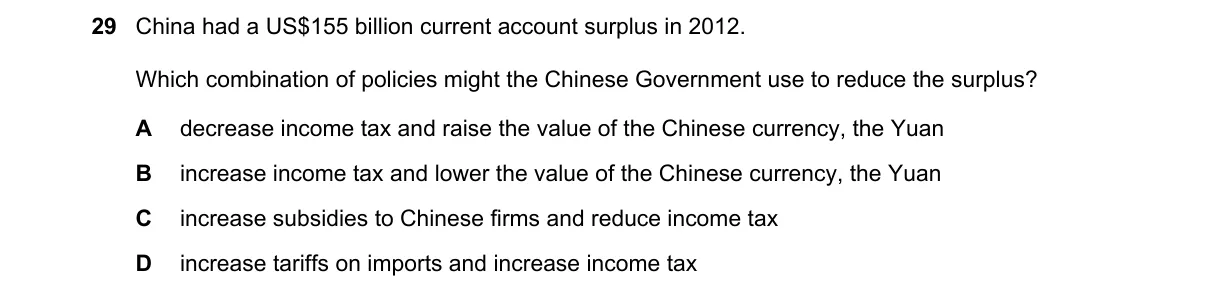
China had a $155 billion current account surplus in 2012. Which combination of policies would raise the Chinese government's income tax revenue and reduce the surplus?
Answer choices
- Adecrease income tax and raise the value of the Chinese currency, Yuan
- Bincrease subsidies to firms and reduce income tax
- Cincrease income tax and lower the value of the Chinese currency, Yuan
- Dincrease tariffs on imports and decrease income tax
Explanation
Expansionary fiscal policy and currency appreciation reduce surplus while boosting tax revenue via growth
Steps:
- Identify goal: Raise income tax revenue (via broader base from growth) and reduce current account surplus (exports > imports).
- Decreasing income tax stimulates consumption and GDP growth, expanding the tax base to increase revenue despite lower rates (Laffer curve effect).
- Raising Yuan value appreciates currency, making exports costlier and imports cheaper, narrowing net exports and surplus.
- Combine effects: Growth raises revenue; appreciation curbs exports—both reduce surplus.
Why A is correct:
- Aligns with open-economy macro: Expansionary policy (lower taxes) boosts imports and GDP (CA = NX + net transfers; higher Y reduces CA surplus), while appreciation directly cuts NX per exchange rate pass-through.
Why the others are wrong:
- B: Subsidies and lower taxes expand economy but directly cut tax revenue without currency adjustment to reduce surplus.
- C: Higher taxes contract economy (lowers revenue base) and depreciation boosts exports, increasing surplus.
- D: Tariffs raise import costs (worsens surplus); lower taxes cut revenue directly.
Final answer: A
Topic: Policies to correct imbalances in the current account of the balance of payments
Practice more A Level Economics (9708) questions on mMCQ.me