A Level Economics (9708)•9708/12/M/J/18
A Level Economics (9708) — 9708/12/M/J/18, Question 21
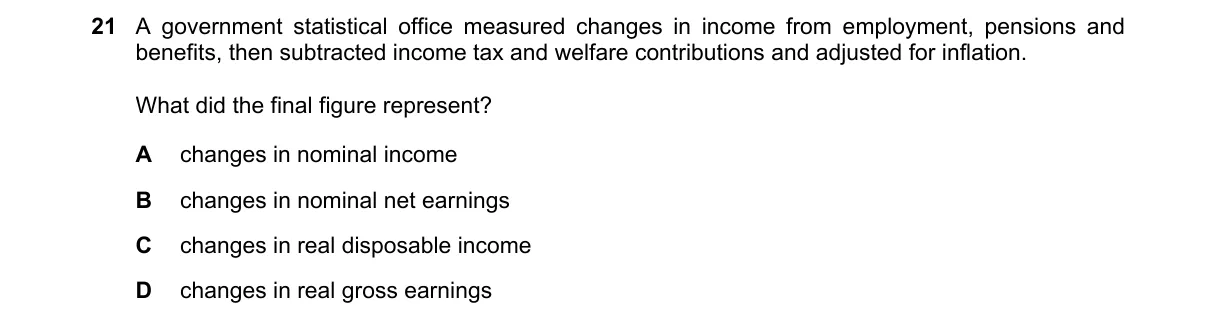
A government statistical office measures changes in income from employment, pensions and benefits, then subtract income tax and welfare contributions and adjusted for inflation. What does the final figure represent?
Answer choices
- Achanges in nominal income
- Bchanges in nominal net earnings
- Cchanges in real disposable income
- Dchanges in real earnings
Explanation
Measuring Real Disposable Income
Steps:
- Include all income sources: employment, pensions, and benefits.
- Subtract deductions: income tax and welfare contributions to get net income.
- Adjust for inflation: converts nominal values to real terms, reflecting purchasing power.
- Combine steps: yields changes in real disposable income after taxes and inflation.
Why C is correct:
- Disposable income is defined as total income minus taxes and contributions, with "real" adjustment for inflation to show true economic changes.
Why the others are wrong:
- A: Ignores inflation adjustment, so it's not "real."
- B: "Nominal" means no inflation adjustment; also, "earnings" typically excludes pensions/benefits.
- D: "Earnings" refers to pre-tax income from work, excluding pensions/benefits and post-tax adjustments.
Final answer: C
Topic: National income statistics
Practice more A Level Economics (9708) questions on mMCQ.me