A Level Economics (9708)•9708/12/M/J/18
A Level Economics (9708) — 9708/12/M/J/18, Question 14
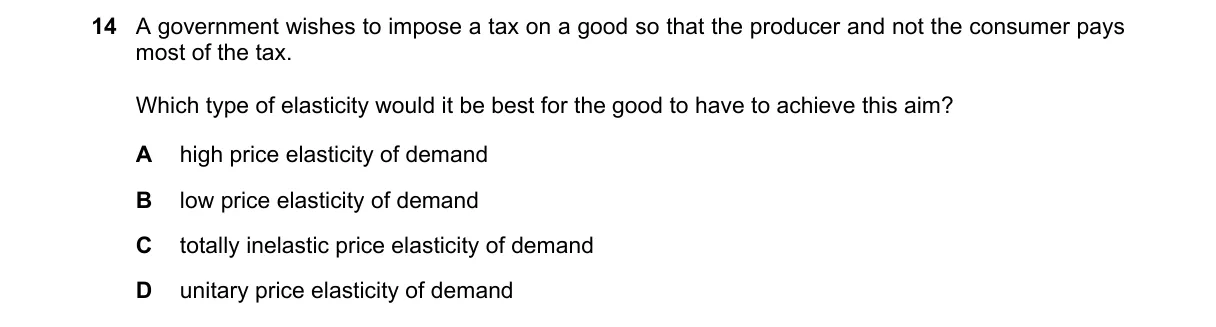
A government wishes to impose a tax on a good so that the producer and not the consumer pays most of the tax. Which type of elasticity of demand would be best for the good to have to achieve this?
Answer choices
- AHigh price elasticity of demand
- BLow price elasticity of demand
- CTotally inelastic price elasticity of demand
- DUnitary price elasticity of demand
Explanation
Tax Incidence and Elasticity of Demand
Steps:
- Tax on a good raises price for consumers and lowers net price for producers; incidence depends on relative elasticities.
- Burden falls more on the less elastic side: inelastic demand means consumers pay more, elastic demand means producers pay more.
- To shift most burden to producers, demand must be highly elastic so quantity demanded drops sharply with price rise.
- High elasticity forces producers to absorb tax via lower net receipts to maintain sales.
Why A is correct:
- High price elasticity means consumers reduce quantity significantly when price rises, so producers bear most tax to avoid lost sales (per tax incidence theorem).
Why the others are wrong:
- B: Low elasticity means consumers bear more tax as they continue buying despite price increase.
- C: Totally inelastic demand places entire tax burden on consumers, who buy the same amount regardless of price.
- D: Unitary elasticity splits tax burden equally between consumers and producers.
Final answer: A
Topic: Price elasticity, income elasticity and cross elasticity of demand
Practice more A Level Economics (9708) questions on mMCQ.me