A Level Economics (9708)•9708/11/M/J/18
A Level Economics (9708) — 9708/11/M/J/18, Question 7
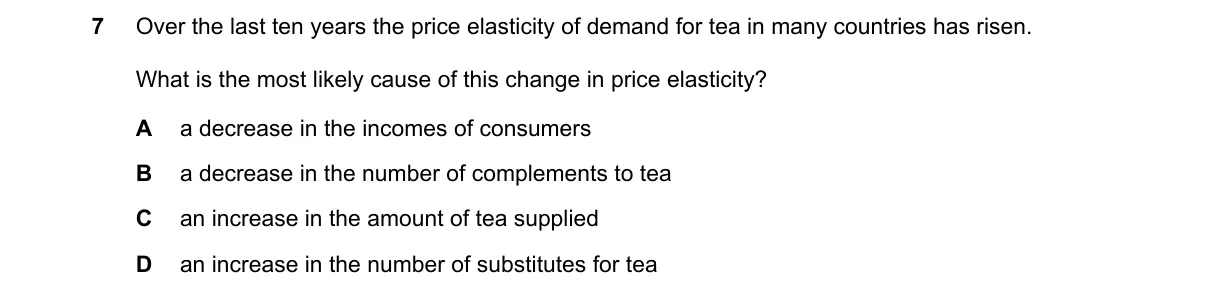
Over the last years the price elasticity of demand for tea in many countries has risen. What is the most likely cause of this increase in price elasticity?
Answer choices
- AA decrease in incomes of consumers
- BA decrease in the number of complements to tea
- CAn increase in the amount of tea supplied
- DAn increase in the number of substitutes for tea
Explanation
Price Elasticity Rises with More Substitutes
Steps:
- Recall that price elasticity of demand measures how quantity demanded responds to price changes.
- Identify factors affecting elasticity: availability of substitutes, necessity, time horizon, and income proportion.
- Analyze the trend: rising elasticity means demand is becoming more responsive to price.
- Evaluate choices: focus on substitutes, as they directly influence consumer switching behavior.
Why D is correct:
- Price elasticity of demand increases when more substitutes are available, per the law of demand, because consumers can easily switch to alternatives if tea prices rise, making quantity demanded more sensitive to price.
Why the others are wrong:
- A: Lower incomes make demand less elastic for necessities like tea, as consumers cut back less on essentials.
- B: Fewer complements would increase tea consumption but doesn't affect price responsiveness.
- C: Higher supply impacts price levels, not the elasticity of demand curve.
Final answer: D
Topic: Price elasticity, income elasticity and cross elasticity of demand
Practice more A Level Economics (9708) questions on mMCQ.me