A Level Economics (9708)•9708/11/M/J/18
A Level Economics (9708) — 9708/11/M/J/18, Question 25
The graphs show the production possibilities for commodities X and Y in two countries M and N. What will be the effect of an agreement between M and N to exchange the commodities at a rate of 1Y for 3X?
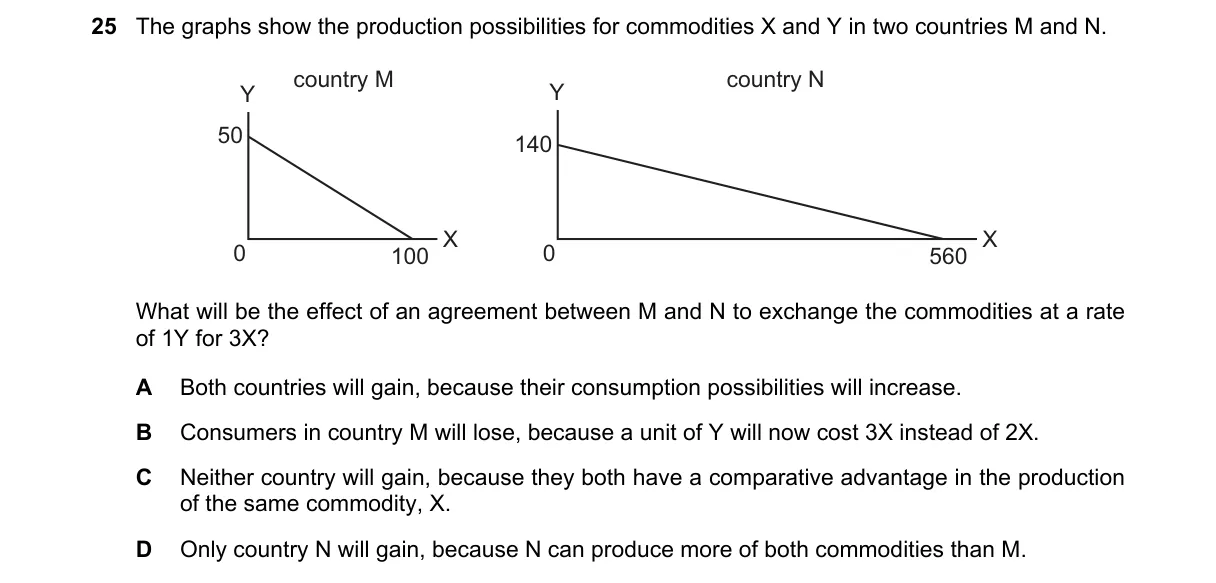
Answer choices
- ABoth countries will gain, because a unit of Y will now cost 3X instead of 4X.
- BConsumers in M will gain, because a unit of Y will now cost 3X instead of 4X.
- CNeither country will gain, because they both have a comparative advantage in the production of X.
- DOnly country N will gain, because N can produce more of both commodities than M.
Explanation
Gains from Trade via Comparative Advantage
Steps:
- Identify opportunity costs: In M, 1Y costs 4X; in N, 1Y costs 2X (from PPF slopes).
- Compare trade rate: 1Y for 3X lies between 2X and 4X.
- Determine specialization: M produces Y (lower opp cost), N produces X.
- Assess gains: Both trade at terms better than autarky, increasing consumption.
Why A is correct:
- Terms of trade (3X per Y) exceed N's cost (2X) but below M's (4X), allowing mutual gains per comparative advantage theory.
Why the others are wrong:
- B: Both gain, not just M, as N trades Y for more X than its cost.
- C: M has comparative advantage in Y, N in X; trade exploits this for gains.
- D: Absolute advantage irrelevant; comparative advantage drives N's gains too.
Final answer: A
Topic: The reasons for international trade
Practice more A Level Economics (9708) questions on mMCQ.me