A Level Accounting (9706)•9706/13/O/N/24
A Level Accounting (9706) — 9706/13/O/N/24, Question 30
A company is considering reducing the selling price of its product by $1 per unit. Why might it use cost-volume-profit analysis in this decision?
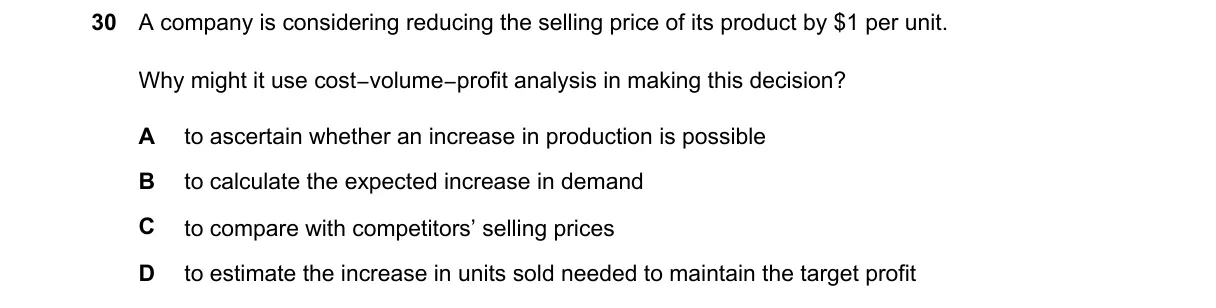
Answer choices
- Ato ascertain whether an increase in production is possible
- Bto compare with competitors' prices
- Cto calculate the expected increase in units sold
- Dto estimate the increase in units sold to maintain target profit
Explanation
CVP Analysis for Price Change Impact
Steps:
- Identify the decision: Reducing price by $1 lowers contribution margin per unit, potentially reducing total profit unless volume increases.
- Recall CVP purpose: It models how changes in price, volume, or costs affect profit using formulas like target profit = (fixed costs + target profit) / contribution margin per unit.
- Apply to scenario: Calculate required sales volume to achieve the same profit level after the price cut.
- Evaluate choices: Select the option aligning with estimating volume needed for target profit maintenance.
Why D is correct:
- CVP's target profit formula determines units sold = (fixed costs + target profit) / (selling price - variable cost per unit), directly estimating volume increase to offset reduced margin.
Why the others are wrong:
- A: CVP focuses on profit relationships, not production capacity assessment.
- B: Competitor pricing is market analysis, outside CVP's financial modeling scope.
- C: CVP estimates volume for profit targets but doesn't predict actual sales increases without demand elasticity data.
Final answer: D
Topic: Costs and cost behaviour
Practice more A Level Accounting (9706) questions on mMCQ.me