A Level Accounting (9706)•9706/13/O/N/24
A Level Accounting (9706) — 9706/13/O/N/24, Question 3
Which accounting concepts are applied when a business makes an annual charge for depreciation of non-current assets?
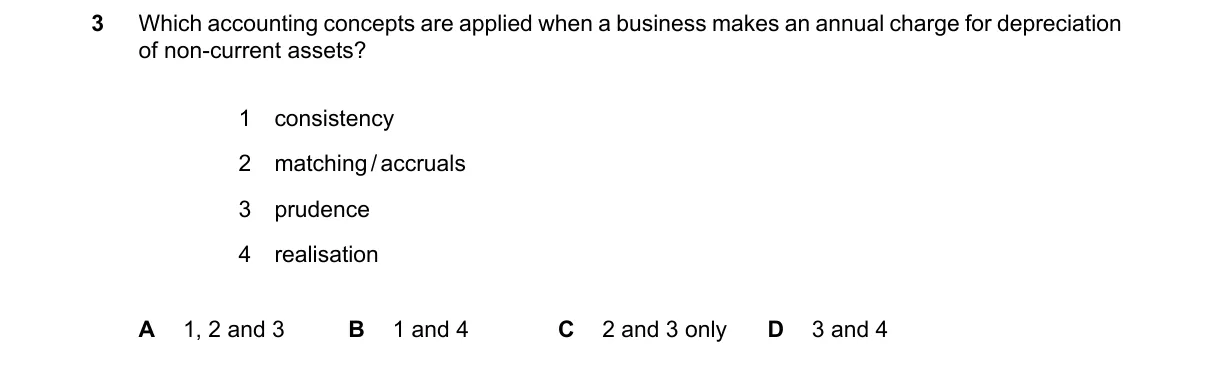
Answer choices
- A1, 2 and 3
- B1 and 4
- C2 and 3 only
- D3 and 4
Explanation
Depreciation applies key accounting concepts for asset allocation
Steps:
- Identify purpose of depreciation: allocates cost of non-current assets over useful life to match expenses with revenues.
- Link to matching concept (1): ensures depreciation expense is charged in periods benefiting from asset use.
- Link to going concern (2): assumes business continues, justifying systematic depreciation rather than immediate write-off.
- Link to prudence (3): provides conservative estimate by recognizing expense annually, avoiding overstatement of assets/profits.
- Exclude accrual (4): not directly applied, as depreciation is non-cash but timing-focused.
Why A is correct:
- A combines 1 (matching), 2 (going concern), and 3 (prudence), all essential for annual depreciation per accounting standards like IAS 16.
Why the others are wrong:
- B omits prudence (3), ignoring conservative asset valuation.
- C excludes matching (1), core to expense-revenue alignment.
- D misses going concern (2) and matching (1), incomplete for ongoing allocation.
Not enough information on exact definitions of 1–4, but based on standard concepts, A fits.
Final answer: A
Topic: Accounting for non-current assets
Practice more A Level Accounting (9706) questions on mMCQ.me