A Level Accounting (9706)•9706/11/O/N/24
A Level Accounting (9706) — 9706/11/O/N/24, Question 15
A business maintains an allowance for irrecoverable debts of 2% of trade receivables. At the beginning of the financial year on 1 January the trade receivables total was $48,000. At the end of the financial year on 31 December the trade receivables total was $50,000. When the business owner prepared the statement of profit or loss for the year ended 31 December, no irrecoverable debt of $1,600 which had occurred during the year had been written off. By which amount was the profit for the year overstated?
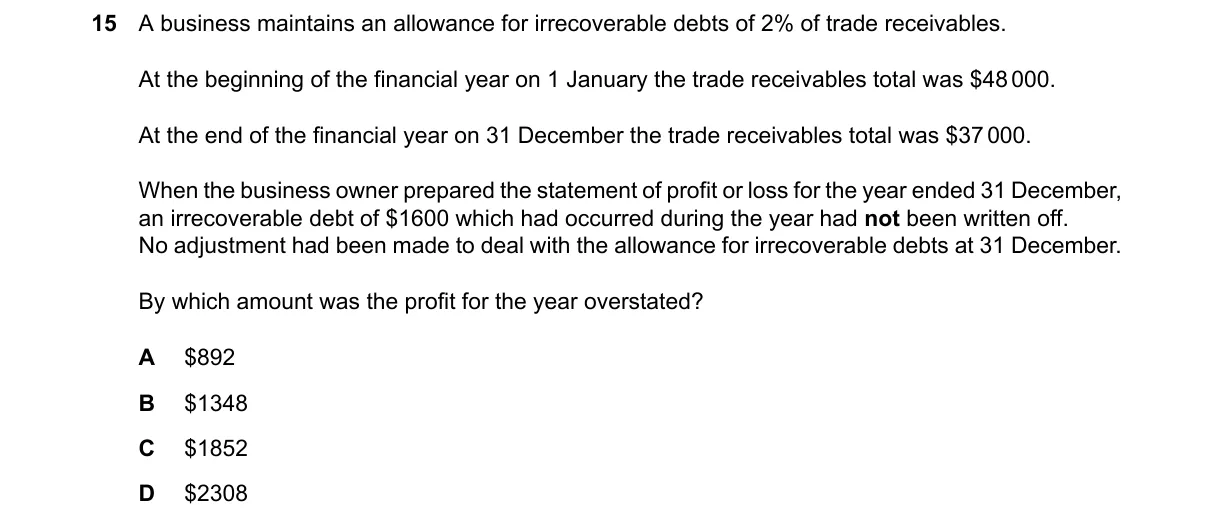
Answer choices
- A$384
- B$1,608
- C$1,652
- D$3,208
Explanation
Bad Debt Expense Understatement Due to Unwritten-Off Debt Steps:
- Calculate beginning allowance: 2% × 960.
- Adjust ending receivables for unwritten-off debt: 1,600 = $48,400.
- Calculate required ending allowance: 2% × 968.
- Allowance after hypothetical write-off: 1,600 = -968 - (-1,608. Why B is correct:
- Under the allowance method, bad debt expense equals write-offs plus net change in allowance (968 - 1,608, which was not recorded, overstating profit by this full amount. Why the others are wrong:
- A: Incorrectly applies 2% to half the receivables change or similar miscalculation.
- C: Adds extraneous 2% to 1,000) plus 1,652), ignoring proper allowance mechanics.
- D: Doubles the expense or adds beginning allowance erroneously (8).
Final answer: B
Topic: Preparation of financial statements
Practice more A Level Accounting (9706) questions on mMCQ.me