A Level Accounting (9706)•9706/13/O/N/23
A Level Accounting (9706) — 9706/13/O/N/23, Question 30
Which assumption does not apply cost-volume-profit (CVP) analysis?
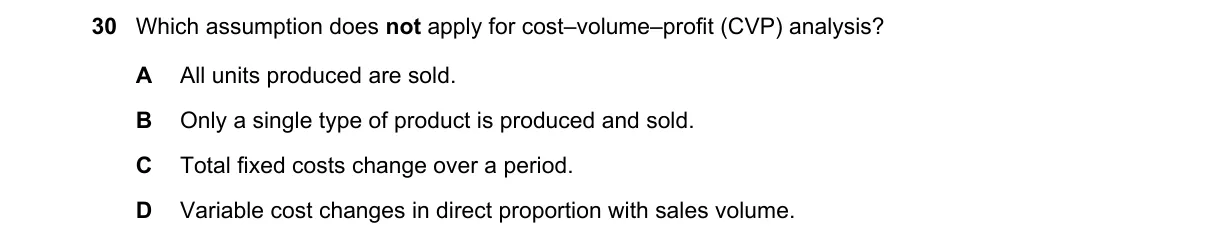
Answer choices
- AAll units produced are sold
- BOnly one type of product is produced and sold.
- CTotal fixed costs change over a period.
- DVariable cost changes in direct proportion with sales volume.
Explanation
Invalid Assumption in CVP Analysis
Steps:
- Recall CVP assumptions: fixed costs constant in total, variable costs proportional to volume, single product or constant mix, all output sold.
- Compare choice A: matches no-inventory assumption.
- Compare choice B: matches single-product assumption.
- Compare choice C: contradicts fixed costs constancy.
- Compare choice D: matches proportionality of variable costs.
Why C is correct:
- CVP analysis assumes total fixed costs remain constant within the relevant range, as per the break-even formula (Break-even point = Fixed Costs / (Unit Selling Price - Unit Variable Cost)).
Why the others are wrong:
- A: CVP requires all units produced to be sold to avoid inventory distortions in volume-profit relationships.
- B: CVP simplifies by assuming one product or constant sales mix for clear analysis.
- D: CVP defines variable costs as changing directly with sales volume for linear projections.
Final answer: C
Topic: Costs and cost behaviour
Practice more A Level Accounting (9706) questions on mMCQ.me