A Level Accounting (9706)•9706/12/O/N/23
A Level Accounting (9706) — 9706/12/O/N/23, Question 25
A manufacturing business has a service department, X, and production departments Y and Z. Department Z is labour intensive. How is the overhead absorption rate for department Z?
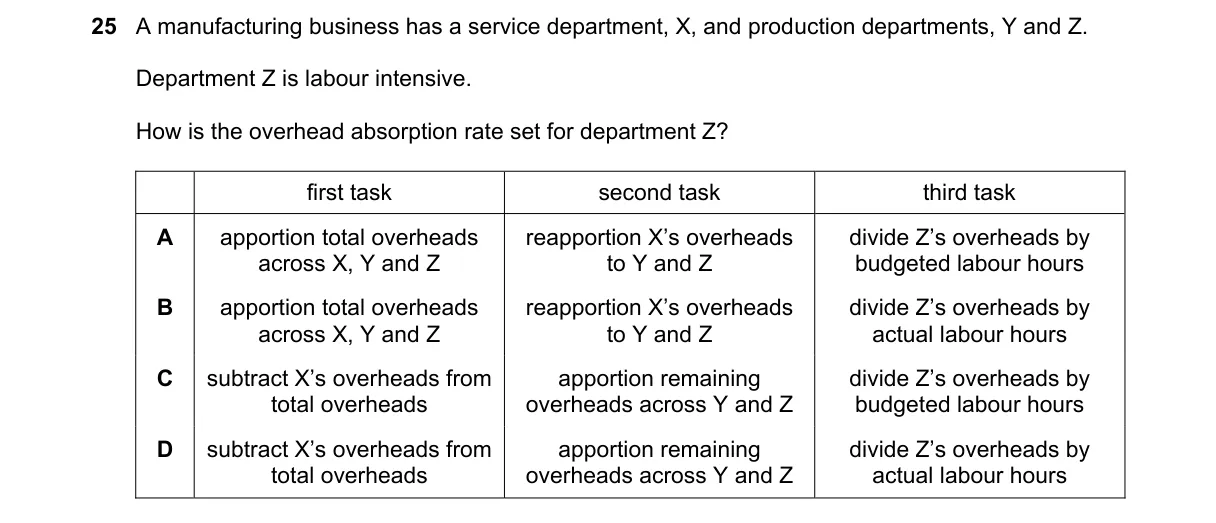
Answer choices
- Atotal overheads apportioned across Y and Z reapportioned to Y and Z divided by budgeted labour hours for Y and Z
- Btotal overheads apportioned across Y and Z reapportioned to Y and Z divided by actual labour hours for Y and Z
- Ctotal overheads for Z from apportionment remaining to Y and Z divided by budgeted labour hours for Z
- Dtotal overheads for Z from apportionment remaining to Y and Z divided by actual labour hours for Z
Explanation
Overhead absorption rate for labour-intensive department Z
Steps:
- Apportion total company overheads initially across service department X and production departments Y and Z.
- Reapportion all of X's overheads to Y and Z using a suitable basis (e.g., labour or area).
- Aggregate the resulting total budgeted overheads assigned to Y and Z after full reapportionment.
- Divide this total by budgeted labour hours for Y and Z to get the per-hour rate, applied to Z as it is labour intensive.
Why A is correct:
- Predetermined overhead absorption rate formula is budgeted overheads (after apportionment and reapportionment to production departments) divided by budgeted activity level (labour hours for labour-intensive operations).
Why the others are wrong:
- B: Relies on actual labour hours, but rates use budgeted figures for planning and control.
- C: Limits overheads to Z only, ignoring the full reapportionment process across Y and Z.
- D: Uses actual labour hours for Z, violating the budgeted basis for predetermined rates.
Final answer: A
Topic: Traditional costing methods
Practice more A Level Accounting (9706) questions on mMCQ.me