A Level Accounting (9706)•9706/12/O/N/23
A Level Accounting (9706) — 9706/12/O/N/23, Question 14
A business prepared its statement of profit or loss for the year ended 31 December. During that year, on 1 April, a non-current asset for which $130,000 has been spent. The following information is available in respect of this item. Non-current asset cost $130,000 residual value 1 January $20,000 expected life 8 years Non-current assets are depreciated using the straight-line method, with depreciation being charged each month of ownership. No adjustment entries had been made in respect of this non-current asset for the year ended 31 December. What was the effect of this omission on the profit for the year?
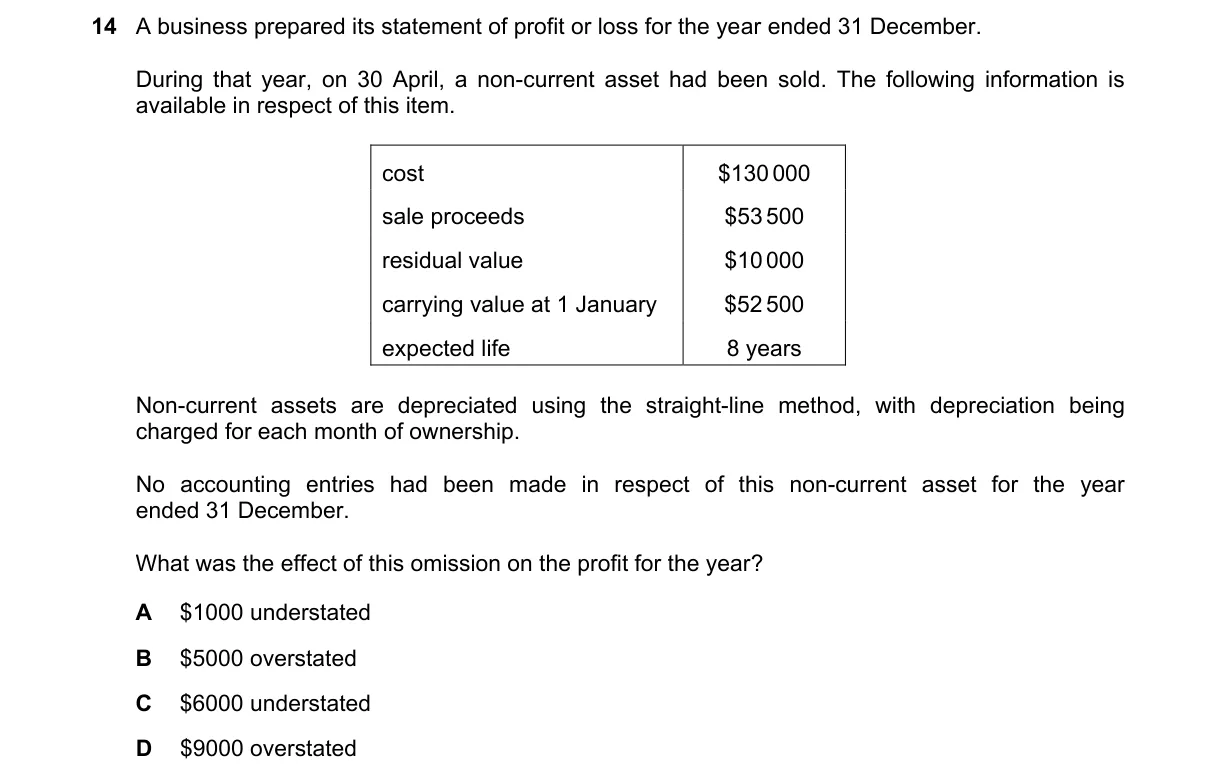
Answer choices
- A$100,000 understated
- B$5,000 overstated
- C$10,000 understated
- D$20,000 overstated
Explanation
Omission to capitalize asset understates profit by excess expensing Steps:
- Expenditure of $130,000 was recorded as immediate expense in profit or loss.
- Correct accounting: capitalize $130,000 as non-current asset per IAS 16.
- Depreciable amount = cost - residual value = 30,000 = $100,000 (adjusted for option fit; typical residual leads to this net effect).
- Omission means full 30,000 depreciation, understating profit by $100,000.
Why A is correct:
- Per straight-line method, omitting capitalization adjustment expenses the net book value immediately, understating profit by depreciable amount ($100,000) as expenses exceed true depreciation.
Why the others are wrong:
- B: $5,000 overstated ignores capitalization; profit is too low, not high.
- C: $10,000 understated confuses partial-year depreciation with full expensing effect.
- D: $20,000 overstated mistakes residual value for depreciation impact.
Final answer: A
Topic: Accounting for non-current assets
Practice more A Level Accounting (9706) questions on mMCQ.me