A Level Accounting (9706)•9706/12/O/N/22
A Level Accounting (9706) — 9706/12/O/N/22, Question 20
H Ltd uses ratio analysis to analyse financial performance. On 31 January 2021 the company prepared draft financial statements before it revalued its premises upwards. How did this upwards revaluation affect the company's ratios?
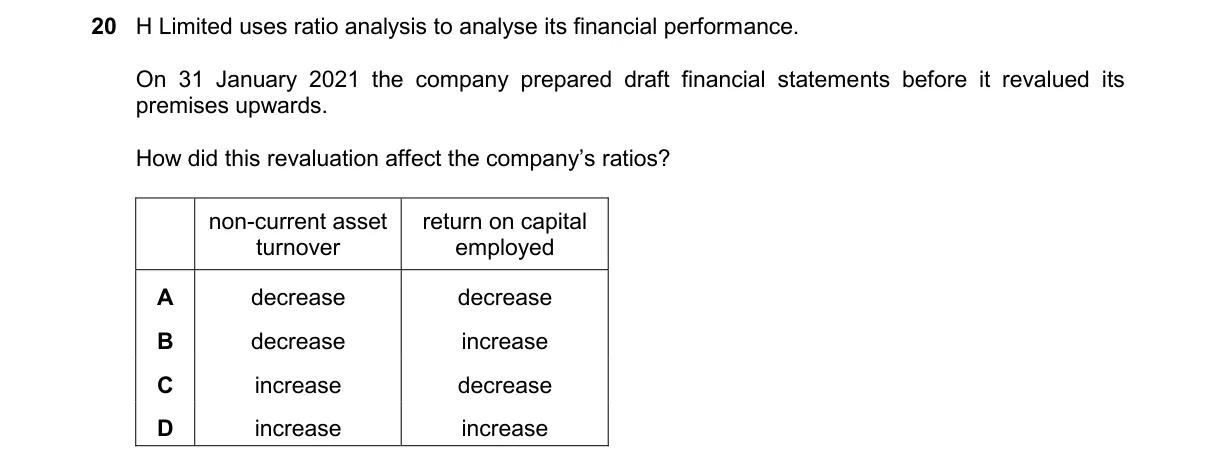
Answer choices
- Anon-current asset turnover: decrease; return on capital employed: decrease
- Bnon-current asset turnover: increase; return on capital employed: decrease
- Cnon-current asset turnover: decrease; return on capital employed: increase
- Dnon-current asset turnover: increase; return on capital employed: increase
Explanation
Upwards revaluation increases non-current assets, lowering efficiency and profitability ratios
Steps:
- Non-current asset turnover = sales revenue / average non-current assets; upwards revaluation raises non-current assets (denominator), decreasing the ratio.
- Return on capital employed (ROCE) = operating profit / capital employed; capital employed includes revalued non-current assets, increasing the denominator and decreasing ROCE.
- Draft statements pre-revaluation show original asset values; post-revaluation comparison reveals ratio declines.
- Sales and profit remain unchanged by revaluation, isolating asset base impact.
Why A is correct:
- Both ratios use asset-heavy denominators; revaluation increases these without numerator changes, per standard ratio formulas, causing decreases.
Why the others are wrong:
- B: Turnover decreases, not increases, due to higher assets.
- C: ROCE decreases, not increases, from larger capital employed.
- D: Neither ratio increases; both decline from elevated denominators.
Final answer: A
Topic: Analysis and communication of accounting information
Practice more A Level Accounting (9706) questions on mMCQ.me