A Level Accounting (9706)•9706/11/O/N/22
A Level Accounting (9706) — 9706/11/O/N/22, Question 10
How closing inventory and loss for the year treated in the financial statements of a sole trader?
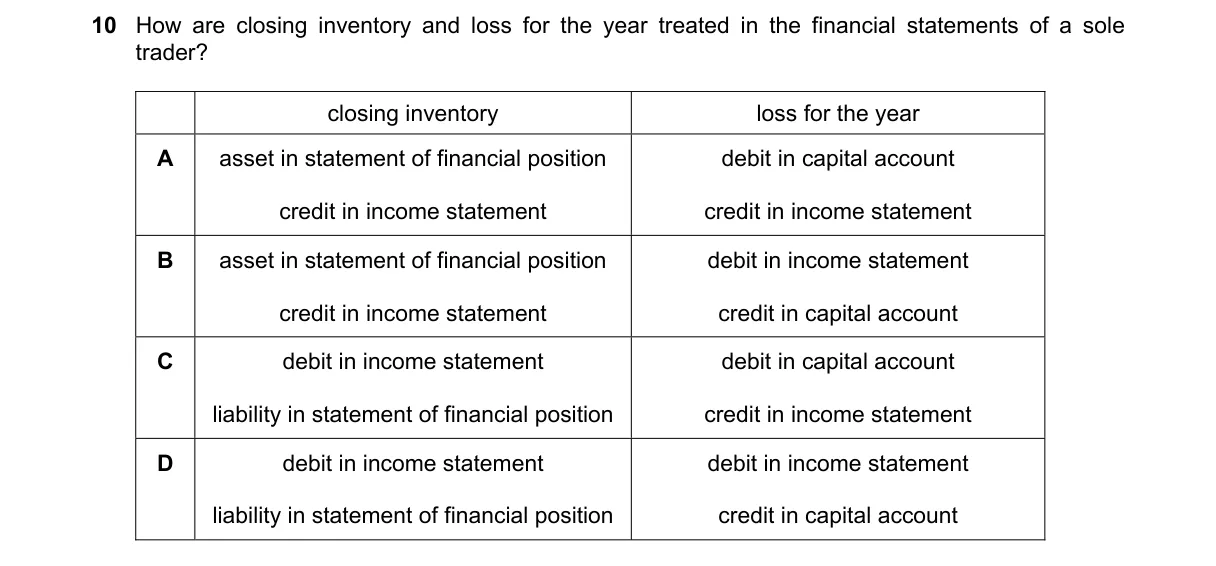
Answer choices
- Aasset in statement of financial position debit in capital account
- Bcredit in income statement debit in income statement
- Cdebit in income statement credit in capital account
- Dliability in statement of financial position credit in capital account
Explanation
Treatment of Closing Inventory and Net Loss in Sole Trader Accounts
Steps:
- Identify closing inventory as unsold goods at year-end, recorded as a current asset in the statement of financial position.
- Recognize net loss as excess of expenses over revenues, calculated in the income statement.
- Adjust owner's capital by debiting the net loss amount to reduce equity in the capital account.
- Confirm no impact on liabilities or direct income statement credits/debits for these items.
Why A is correct:
- Closing inventory is a current asset per accounting standards (IAS 2), shown in the statement of financial position; net loss debits the capital account to reflect reduced owner's equity.
Why the others are wrong:
- B: Closing inventory is not credited in the income statement; losses are not debited there but transferred to capital.
- C: Closing inventory is not debited as an expense in the income statement; losses do not credit capital.
- D: Closing inventory is an asset, not a liability; losses do not credit capital.
Final answer: A
Topic: Preparation of financial statements
Practice more A Level Accounting (9706) questions on mMCQ.me