A Level Accounting (9706)•9706/13/O/N/21
A Level Accounting (9706) — 9706/13/O/N/21, Question 29
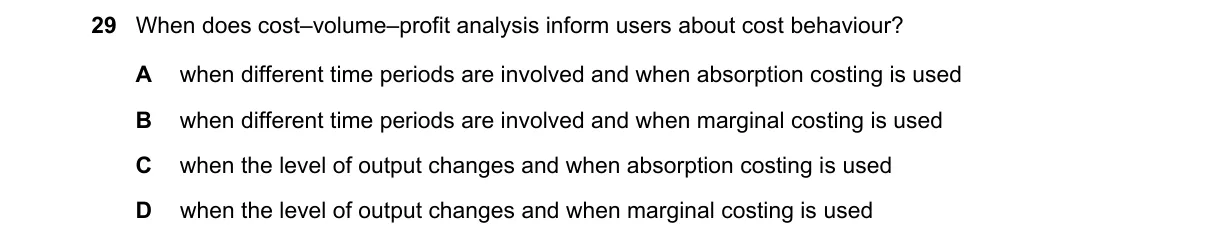
When does cost-volume-profit analysis inform users about cost behaviour?
Answer choices
- Awhen different time periods are involved and when absorption costing is used
- Bwhen different time periods are involved and when marginal costing is used
- Cwhen the level of output changes and when absorption costing is used
- Dwhen the level of output changes and when marginal costing is used
Explanation
CVP Analysis and Cost Behavior Under Marginal Costing
Steps:
- CVP analysis studies the relationship between costs, volume, and profit, focusing on fixed and variable cost separation.
- Cost behavior refers to how costs change with activity levels, like output volume.
- Marginal costing directly classifies costs as fixed or variable, supporting clear CVP insights.
- CVP assumes short-term scenarios with constant time periods but varying output levels.
Why D is correct:
- Marginal costing treats fixed costs as period costs and variable as unit costs, allowing CVP's contribution margin formula (Sales - Variable Costs = Contribution) to directly reveal how total costs behave with output changes.
Why the others are wrong:
- A: Absorption costing spreads fixed overheads over units, obscuring true cost behavior during output changes; time periods add irrelevant variability.
- B: Different time periods violate CVP's short-term, single-period assumption, even with marginal costing.
- C: Absorption costing absorbs fixed costs into unit costs, distorting behavior signals when output varies.
Final answer: D
Topic: Costs and cost behaviour
Practice more A Level Accounting (9706) questions on mMCQ.me