A Level Accounting (9706)•9706/12/O/N/21
A Level Accounting (9706) — 9706/12/O/N/21, Question 28
Details for two products made by a company were as follows. Selling price per unit product X 13 product Y 8 variable cost per unit 11 X 4 Y The company could sell a maximum of 11000 units of X and 9000 units of Y. However, the company can produce more than 10000 units of X and Y together due to production constraints. Which production mix will maximise profits?
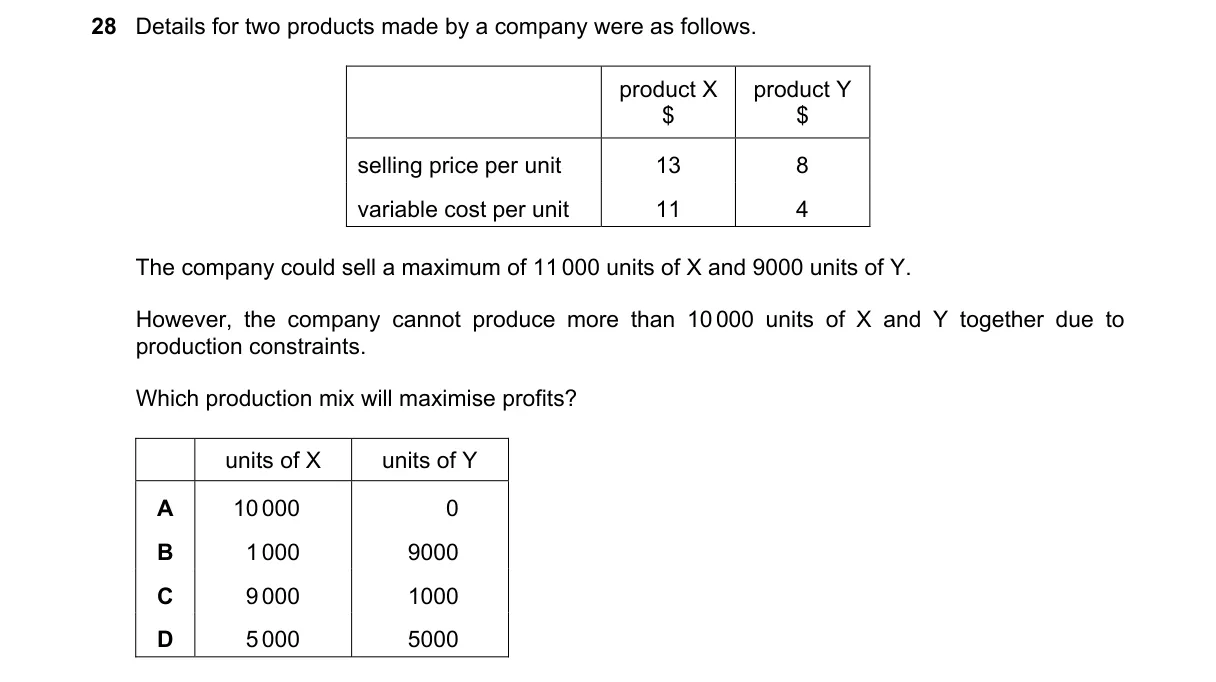
Answer choices
- A10000 units of X 9000 units of Y
- BOption B
- C9000 units of X 10000 units of Y
- D5000 units of X 5000 units of Y
Explanation
Maximize contribution margin under capacity constraint
Steps:
- Calculate contribution per unit: X = 11 = 8 - 4.
- Identify constraints: total production ≤ 10,000 units; max sales X ≤ 11,000, Y ≤ 9,000.
- Prioritize Y due to higher contribution (2): produce max 9,000 Y, then 1,000 X to fill capacity.
- Total contribution for this mix: (9,000 × 2) = $38,000 (highest possible).
Why B is correct:
- Option B (1,000 X and 9,000 Y) maximizes total contribution by allocating full capacity to the higher-margin product first, per limiting factor analysis.
Why the others are wrong:
- A: Total 19,000 units exceeds 10,000 capacity limit.
- C: Total 19,000 units exceeds capacity; also 10,000 Y exceeds 9,000 sales max.
- D: Total contribution 38,000 due to under-prioritizing Y.
Final answer: B
Topic: Costs and cost behaviour
Practice more A Level Accounting (9706) questions on mMCQ.me