A Level Accounting (9706)•9706/12/O/N/21
A Level Accounting (9706) — 9706/12/O/N/21, Question 25
A business had no opening inventory, in one month it produced 4000 units and sold 3500 units. The following information is available. per unit $ selling price variable cost 30 fixed cost 15. How would inventory value and profit vary between using absorption costing and marginal costing?
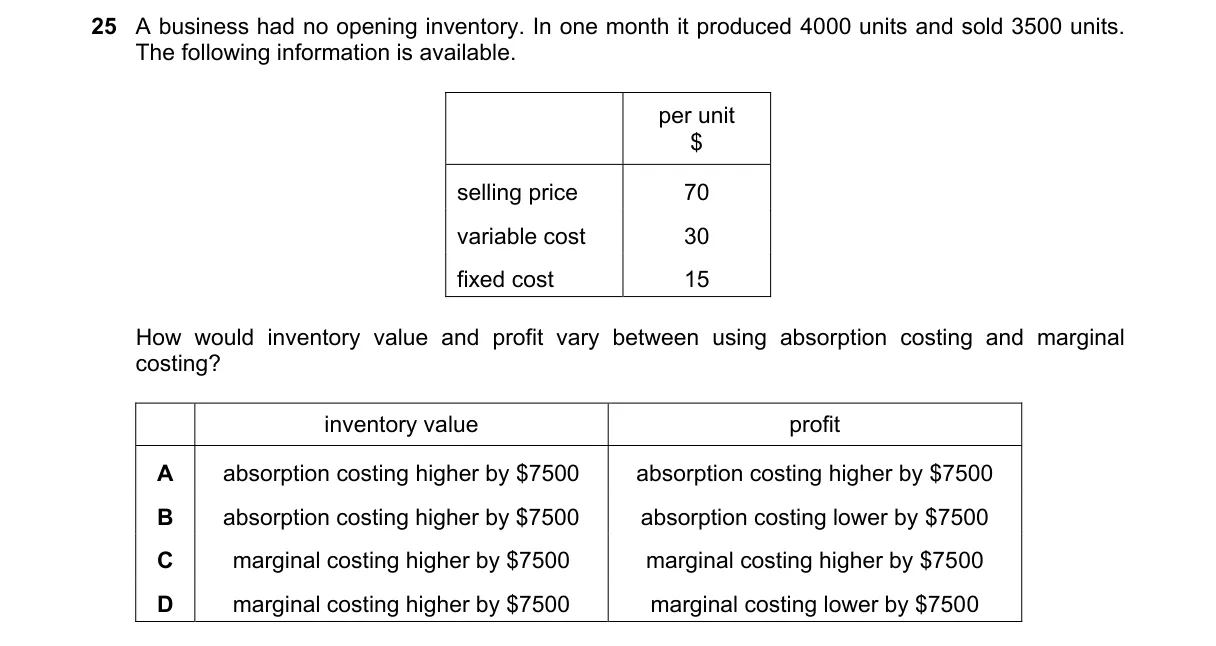
Answer choices
- Aabsorption inventory higher by $5000 absorption profit higher by $5000
- Babsorption costing higher by $5000 absorption costing lower by $5000
- Cmarginal costing higher by $500 marginal costing lower by $7500
- Dmarginal costing higher by $500 marginal costing lower by $7500
Explanation
Fixed Costs in Closing Inventory Drive Differences Steps:
- Closing inventory units = 4000 produced - 3500 sold = 500 units.
- Absorption costing values inventory at variable cost + fixed cost per unit; marginal costing uses only variable cost.
- Inventory difference = 500 units × 5000 higher under absorption.
- With production exceeding sales, absorption profit exceeds marginal profit by $5000 (fixed costs deferred in inventory).
Why A is correct:
- Absorption costing absorbs fixed manufacturing costs into unsold inventory per standard costing principles, raising both inventory value and profit by fixed costs on closing stock when output > sales.
Why the others are wrong:
- B: Reverses profit impact; absorption profit is higher, not lower.
- C: Misattributes higher inventory to marginal costing and uses incorrect $500 difference.
- D: Misattributes higher inventory to marginal costing and mismatches profit variance amount.
Final answer: A
Topic: Traditional costing methods
Practice more A Level Accounting (9706) questions on mMCQ.me