A Level Accounting (9706)•9706/11/O/N/21
A Level Accounting (9706) — 9706/11/O/N/21, Question 14
L and M were partners sharing profits and losses equally. N's capital account was as follows. $ motor vehicle 7000 balance 14000 bank 15000 current account 5000 What explained the entries in the capital account?
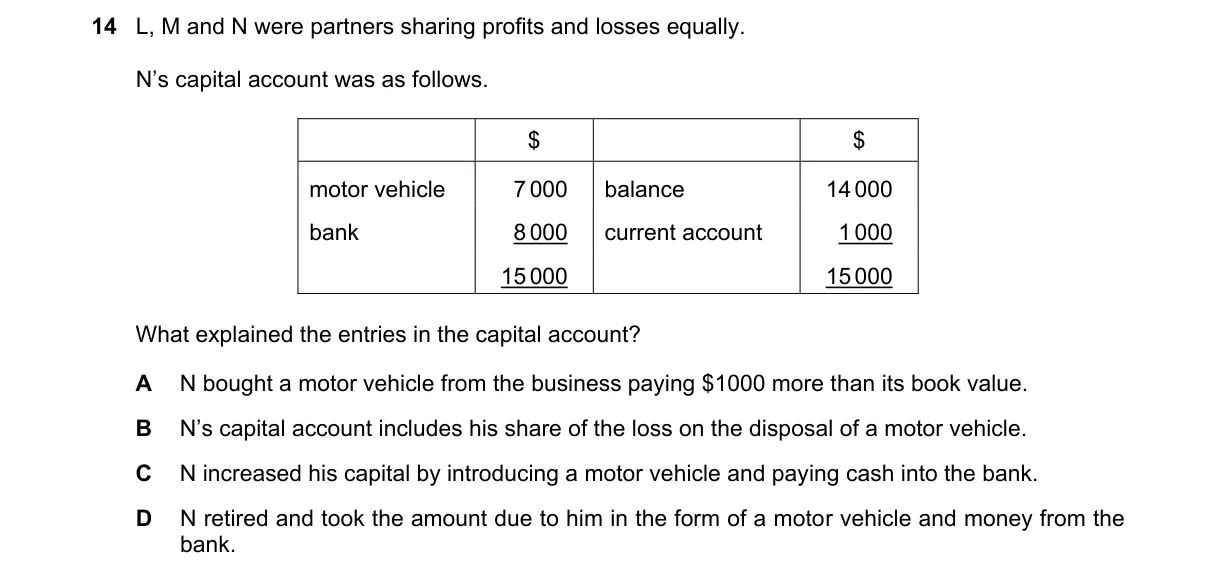
Answer choices
- AN bought a motor vehicle including his share of the business paying $1000 more than its book value.
- BN retired his capital by introducing a motor vehicle and paying cash into the bank.
- CN increased his capital by introducing a motor vehicle and paying cash into the bank.
- Dbank and took the amount due to him in the form of a motor vehicle and money from the bank.
Explanation
Partner Retirement via Asset Withdrawal
Steps:
- Examine entries: Debits to motor vehicle (7000) and bank (15000) show assets transferred out; balance (14000) and current account (5000) reflect capital owed.
- Calculate total withdrawal: 7000 + 15000 = 22000, matching settled capital (14000 + 5000 + implied adjustments).
- Interpret context: Equal profit-sharing implies N's exit; entries align with settlement, not addition.
- Confirm via accounting: Debits reduce partnership assets and partner's capital liability.
Why D is correct:
- Partnership law (e.g., under Partnership Act) allows retiring partner to receive assets in kind or cash to settle capital balance, directly matching debit entries for motor vehicle and bank.
Why the others are wrong:
- A: Purchase would credit N's capital and debit business assets, not debit N's capital account.
- B: Introducing assets for retirement credits capital first, opposite of withdrawal debits shown.
- C: Increasing capital debits bank/motor vehicle to partnership, crediting N's capital—not matching debit pattern.
Final answer: D
Topic: Types of business entity
Practice more A Level Accounting (9706) questions on mMCQ.me