A Level Accounting (9706)•9706/12/O/N/20
A Level Accounting (9706) — 9706/12/O/N/20, Question 20
A company's financial statements for the year ended 31 December showed the following: Issued share capital $150,000 Non-current liabilities $250,000 The company's reserves from operations including retained earnings $160,000 and the profit for the year was $120,000. What was the company's return on capital employed?
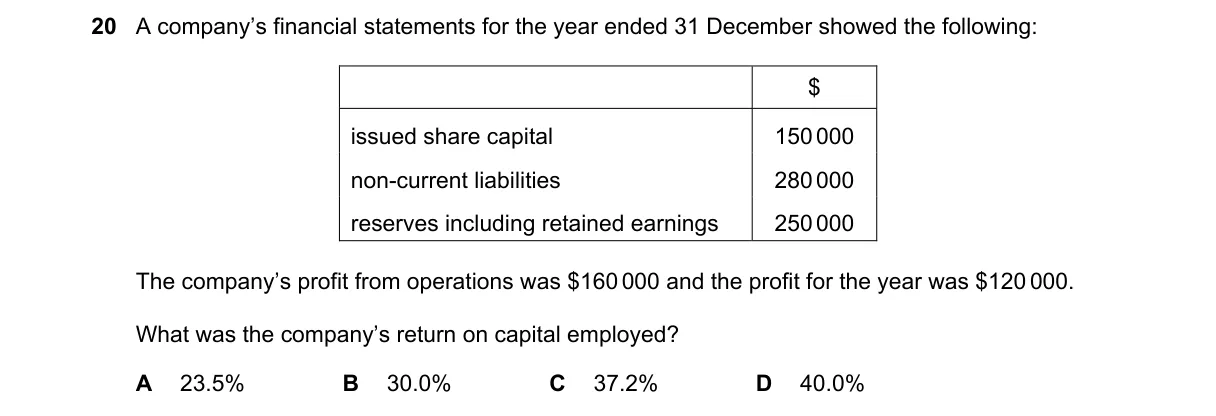
Answer choices
- A23.5%
- B30%
- C37.2%
- D40%
Explanation
Return on capital employed using average capital employed
Steps:
- Subtract profit from reserves to find opening reserves: 120,000 = $40,000.
- Opening capital employed = share capital + opening reserves + non-current liabilities = 40,000 + 440,000.
- Closing capital employed = share capital + reserves + non-current liabilities = 160,000 + 560,000.
- Average capital employed = (560,000) / 2 = 120,000 / $500,000 × 100% = 23.5%.
Why A is correct:
- ROCE formula uses average capital employed (opening + closing / 2) to account for changes during the year, per standard accounting practice.
Why the others are wrong:
- B uses only share capital + non-current liabilities ($400,000), ignoring reserves.
- C uses equity only ($310,000), which is return on equity, not capital employed.
- D uses an arbitrary smaller base ($300,000), violating the capital employed definition.
Final answer: A
Topic: Analysis and communication of accounting information
Practice more A Level Accounting (9706) questions on mMCQ.me