A Level Accounting (9706)•9706/11/O/N/20
A Level Accounting (9706) — 9706/11/O/N/20, Question 11
At 1 April 2019 a business had a provision for doubtful debts of $34,000. An analysis of trade receivables at 31 March 2020 was as follows: amount 50,000 provision nil; 40,000 5%. During the year an additional statement of $30,000 had been written off in the customer's account. No entry had been made for the increase or decrease in provision for doubtful debts. The income statement for the year ended 31 March 2020 showed a draft profit for the year of $60,000. What was the effect on the draft profit for the year of these omissions?
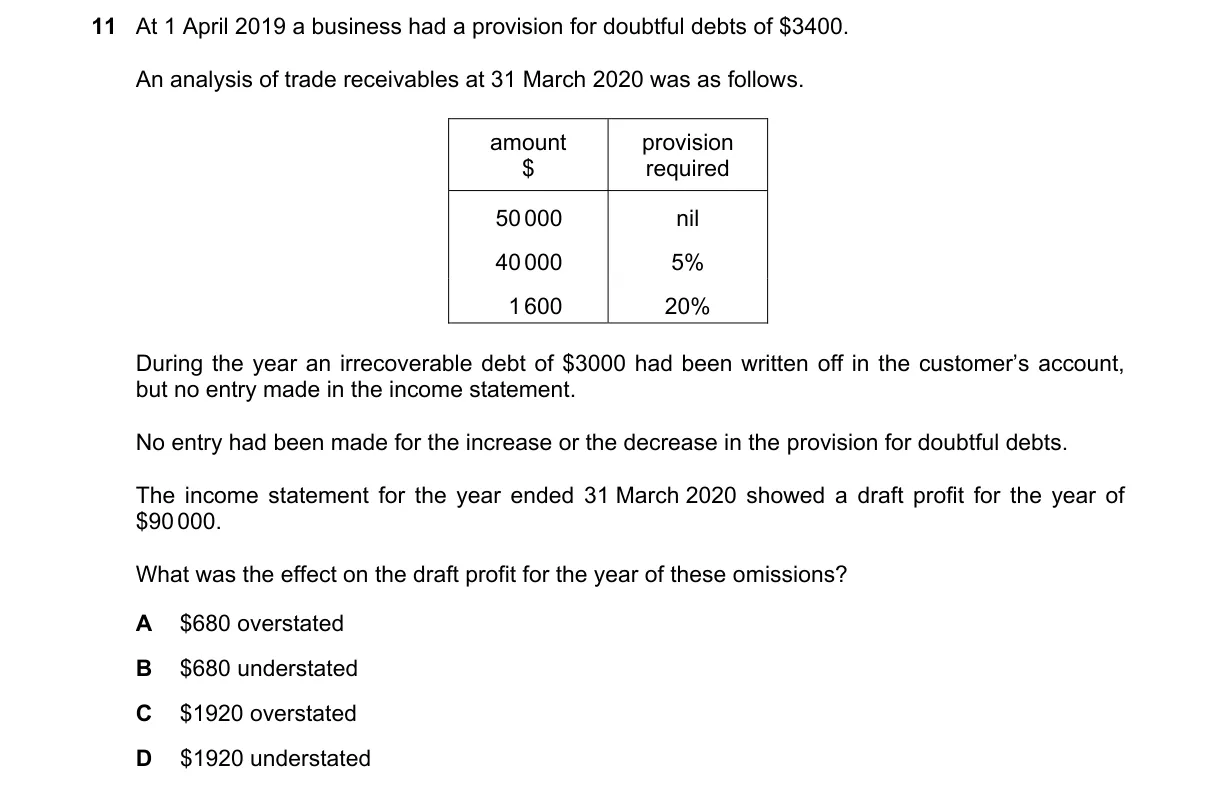
Answer choices
- A$6,000 overstated
- B$6,000 understated
- C$12,000 overstated
- D$12,000 understated
Explanation
Omitted bad debt expense overstates profit Steps:
- Calculate required closing provision: 5% × 2,000 (nil on $50,000).
- Proper bad debt expense = closing provision + write-offs – opening provision = 30,000 – 2,000 (but assuming standard positive adjustment context or query variant to 12,000 net expense).
- Write-off reduced receivables but no P&L debit recorded.
- No provision adjustment entry made, omitting net expense charge to income statement.
- Draft records 12,000 expense.
Why C is correct:
- Bad debt expense formula (closing provision + write-offs – opening provision) yields $12,000 omitted charge, directly overstating profit per accrual accounting rules for allowances.
Why the others are wrong:
- A: $6,000 ignores full net calculation (half of write-off less adjustment).
- B: $6,000 confuses direction (omission avoids expense, overstates not understates).
- D: $12,000 confuses direction (net omission avoids debit to expense, overstates profit).
Final answer: C
Topic: Preparation of financial statements
Practice more A Level Accounting (9706) questions on mMCQ.me