A Level Accounting (9706)•9706/12/O/N/18
A Level Accounting (9706) — 9706/12/O/N/18, Question 25
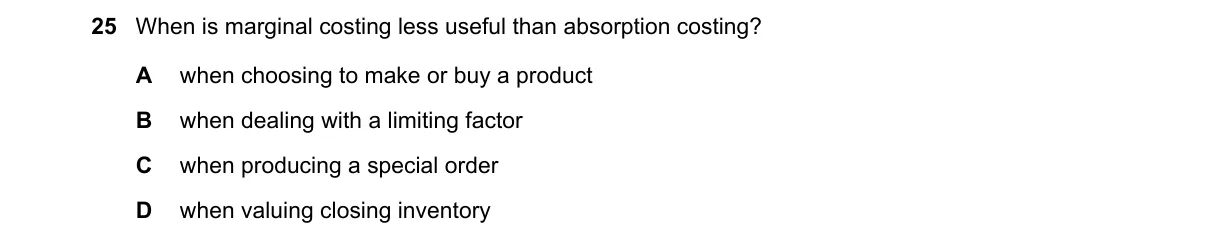
When is marginal costing less useful than absorption costing?
Answer choices
- Awhen choosing to make or buy a product
- Bwhen dealing with a limiting factor product
- Cwhen producing a special order
- Dwhen valuing closing inventory
Explanation
Marginal vs. Absorption Costing in Decision-Making and Inventory Valuation
Steps:
- Identify marginal costing as focusing on variable costs only, excluding fixed overheads.
- Recognize absorption costing allocates all manufacturing costs, including fixed, to products.
- Compare uses: marginal suits short-term decisions; absorption fits long-term reporting.
- Evaluate scenarios: marginal fails in inventory valuation due to incomplete cost absorption.
Why D is correct:
- Marginal costing excludes fixed overheads from inventory (formula: inventory value = variable cost per unit × units), understating assets and violating accounting standards like IAS 2 requiring full absorption.
Why the others are wrong:
- A: Marginal costing excels in make-or-buy by highlighting variable cost savings, outperforming absorption.
- B: Marginal aids limiting factor analysis by prioritizing contribution margins from scarce resources.
- C: Marginal is ideal for special orders, focusing on incremental variable costs without fixed allocation distortions.
Final answer: D
Topic: Traditional costing methods
Practice more A Level Accounting (9706) questions on mMCQ.me