A Level Accounting (9706)•9706/11/O/N/18
A Level Accounting (9706) — 9706/11/O/N/18, Question 22
A business uses absorption costing and applies an overhead absorption rate based on direct labour hours. Why does the business distinguish between direct and indirect labour? 1 to aid preparation of a quote 2 to assist when planning production 3 to assist purchasing materials
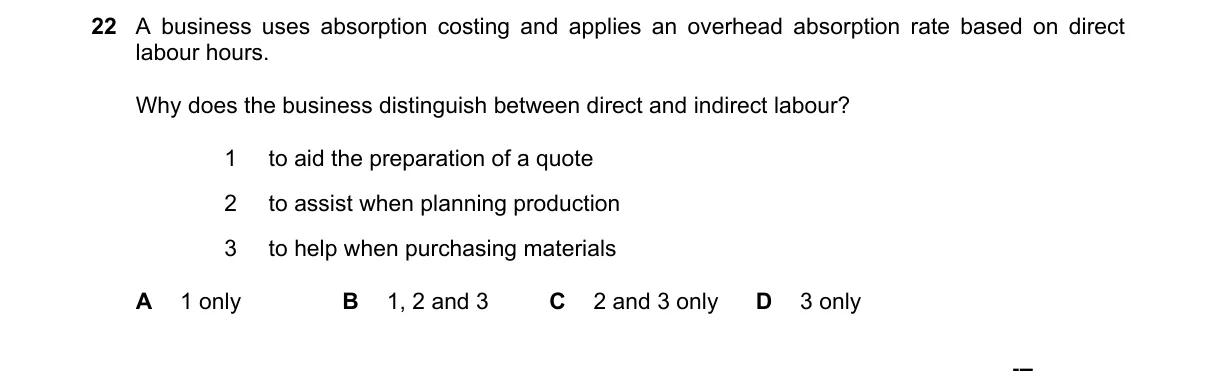
Answer choices
- A1 only
- B1,2 and 3
- C2 and 3 only
- D3 only
Explanation
Distinguishing direct vs. indirect labour for accurate overhead absorption
Steps:
- In absorption costing, overheads are absorbed using a predetermined rate based on direct labour hours only.
- Direct labour is traceable to products; indirect labour is part of overhead costs, not the absorption base.
- Distinguishing ensures the absorption rate (total overheads ÷ budgeted direct labour hours) accurately reflects product costs.
- This precise costing supports full cost pricing, directly aiding quote preparation.
Why A is correct:
- Absorption costing formula requires overhead rate = budgeted overheads ÷ budgeted direct labour hours; distinguishing labour types ensures only direct hours are used as the base for product costing in quotes.
Why the others are wrong:
- B includes 2 and 3, but production planning and material purchasing do not rely on labour type distinction for overhead absorption.
- C omits 1; planning and purchasing are unrelated to calculating direct labour-based rates.
- D ignores 1 and 2; purchasing materials involves costs unrelated to labour classification.
Final answer: A
Topic: Traditional costing methods
Practice more A Level Accounting (9706) questions on mMCQ.me