A Level Accounting (9706)•9706/13/M/J/25
A Level Accounting (9706) — 9706/13/M/J/25, Question 28
How is margin of safety calculated?
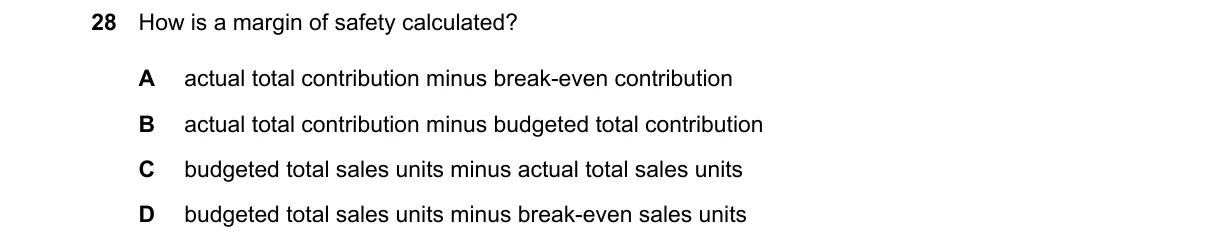
Answer choices
- Aactual total contribution minus budgeted total contribution
- Bbudgeted total units minus actual total units
- Cbudgeted total sales units minus actual sales units
- Dbudgeted total units minus break-even units
Explanation
Margin of safety shows how much sales exceed break-even to avoid losses
Steps:
- Identify break-even units: fixed costs divided by contribution margin per unit.
- Determine budgeted sales units: planned production or sales volume.
- Subtract break-even units from budgeted units to find excess capacity.
- This difference is the margin of safety in units, indicating risk buffer.
Why D is correct:
- Margin of safety formula is budgeted sales minus break-even sales, measuring sales cushion before losses occur.
Why the others are wrong:
- A: Contribution differences relate to profit variance, not safety margin.
- B: Actual vs. budgeted units measure volume variance, ignoring break-even.
- C: Sales unit differences track performance variance, not break-even buffer.
Final answer: D
Topic: Budgeting and budgetary control
Practice more A Level Accounting (9706) questions on mMCQ.me