A Level Accounting (9706)•9706/13/M/J/25
A Level Accounting (9706) — 9706/13/M/J/25, Question 25
Which statements correctly compare the benefits of absorption and marginal costing?
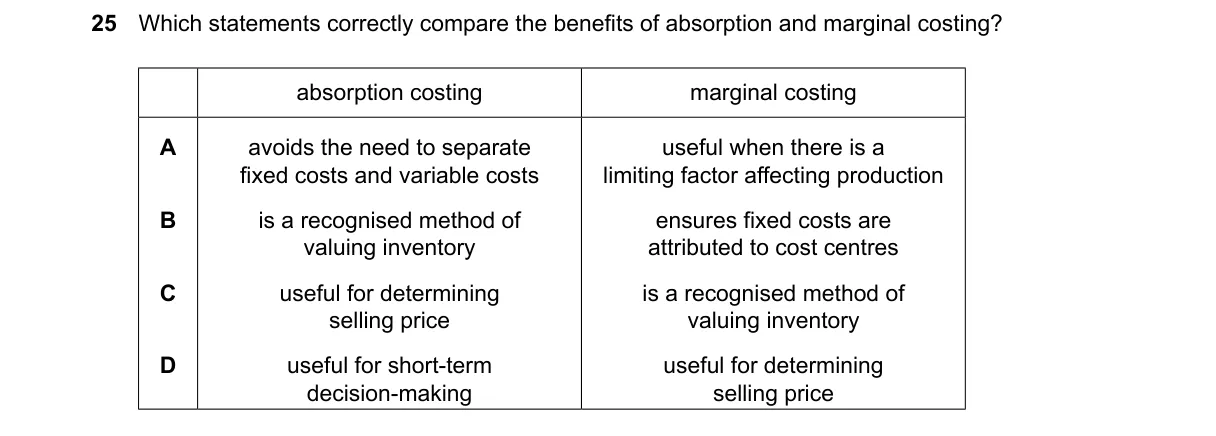
Answer choices
- Aavoids the need to separate fixed and variable costs; useful when there is a limiting factor affecting production
- Bis a valuable method; ensures fixed costs are attributed to cost centres
- Cis useful for valuing inventory; is a recognised method of valuing inventory
- Duseful for short-term decision-making; useful for determining selling price
Explanation
Comparing absorption and marginal costing benefits
Steps:
- Identify absorption costing absorbs fixed overheads into unit costs, avoiding fixed/variable separation.
- Identify marginal costing separates fixed and variable costs for contribution analysis.
- Match choice A: absorption avoids separation; marginal aids limiting factor decisions via contribution per unit of resource.
- Eliminate others for mismatches in benefits.
Why A is correct:
- Absorption includes all costs in inventory per standard accounting (e.g., IAS 2), avoiding separation; marginal uses contribution (sales - variable costs) for limiting factor optimization.
Why the others are wrong:
- B: Vague phrasing; absorption attributes fixed costs but not uniquely to cost centres over marginal.
- C: Marginal undervalues inventory by excluding fixed costs, not recognized for external reporting.
- D: Marginal suits short-term via contribution; absorption better for full-cost selling prices long-term.
Final answer: A
Topic: Traditional costing methods
Practice more A Level Accounting (9706) questions on mMCQ.me