A Level Accounting (9706)•9706/11/M/J/25
A Level Accounting (9706) — 9706/11/M/J/25, Question 25
Which statements correctly compare the benefits of absorption and marginal costing?
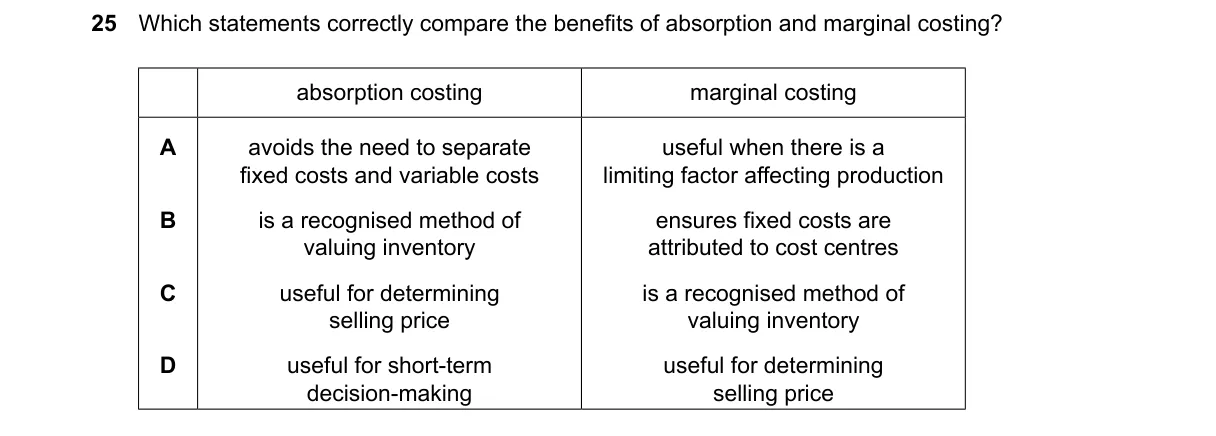
Answer choices
- Aavoids the need to separate fixed and variable costs useful when there is limiting factor affecting production
- Bis a valuable method ensures fixed costs are attributed to cost centres
- Cis useful for inventory is a recognised method of valuing inventory
- Duseful for short-term decision-making useful for determining selling price
Explanation
Comparing absorption vs. marginal costing benefits
Steps:
- Identify absorption costing: allocates all manufacturing costs (fixed and variable) to products, avoiding separation of fixed/variable costs.
- Identify marginal costing: focuses on variable costs only, separating them from fixed costs for contribution analysis.
- Match benefits: absorption suits full cost recovery and inventory valuation; marginal aids short-term decisions like limiting factors.
- Evaluate options: select pair where first benefit fits absorption, second fits marginal.
Why A is correct:
- Absorption costing includes fixed overheads in unit costs without separating them (per standard definition), while marginal costing highlights contribution per unit, ideal for limiting factor decisions via ranking by contribution ratio.
Why the others are wrong:
- B: Marginal costing does not attribute fixed costs to centers; absorption does, but B mixes phrasing incorrectly.
- C: Marginal is not standard for inventory valuation (IFRS/GAAP require absorption); the pairing is reversed.
- D: Absorption determines full selling price including fixed costs; marginal suits short-term decisions but not pricing.
Final answer: A
Topic: Traditional costing methods
Practice more A Level Accounting (9706) questions on mMCQ.me