A Level Accounting (9706)•9706/11/M/J/25
A Level Accounting (9706) — 9706/11/M/J/25, Question 2
A business has the following balances at the end of a financial period. Non-current assets $102,000. Long-term loan $50,000. Trade receivables $39,000. Trade payables $27,000. Profit for the period $32,000. What is the owner's capital account at the end of the financial period?
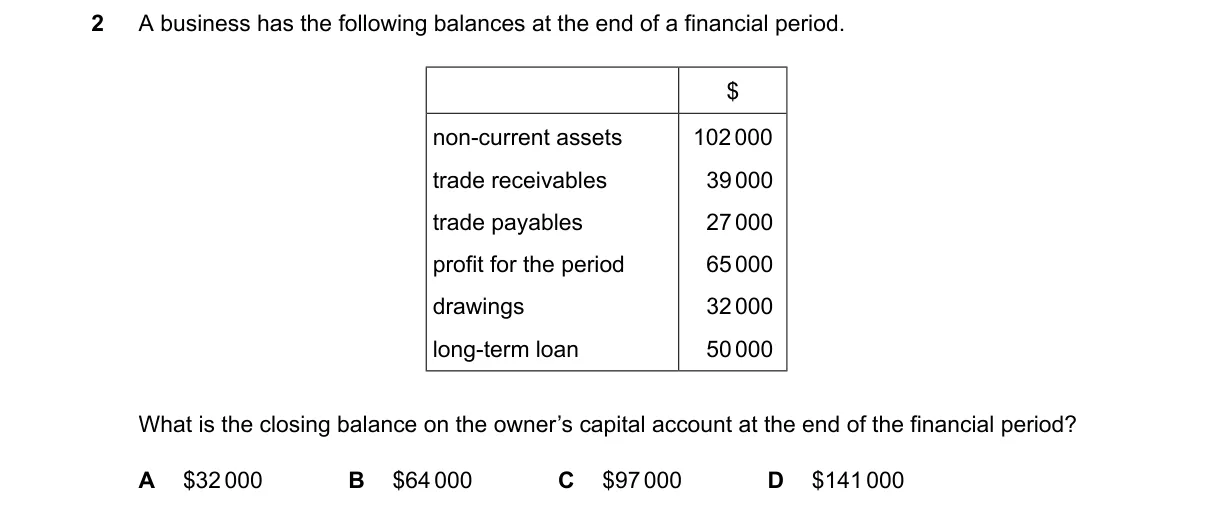
Answer choices
- A$32,000
- B$64,000
- C$97,000
- D$114,000
Explanation
Owner's capital from accounting equation Steps:
- Calculate total assets: Non-current assets 39,000 = $141,000.
- Calculate total liabilities: Long-term loan 27,000 = $77,000.
- Apply accounting equation: Assets = Liabilities + Capital, so Capital = Total assets - Total liabilities = 77,000 = $64,000.
- Profit $32,000 is already reflected in assets, increasing capital for the period. Why B is correct:
- B $64,000 matches Capital = Assets - Liabilities per the fundamental accounting equation. Why the others are wrong:
- A $32,000: Only the profit, ignores net assets from other balances.
- C $97,000: Total assets minus payables only, excludes long-term loan.
- D $114,000: Total assets plus profit, double-counts the profit already in assets.
Final answer: B
Topic: Preparation of financial statements
Practice more A Level Accounting (9706) questions on mMCQ.me