A Level Accounting (9706)•9706/12/M/J/23
A Level Accounting (9706) — 9706/12/M/J/23, Question 29
A company manufactures three products: X, Y and Z. The table provides per unit information concerning the three products. selling price per unit product X product Y product Z $100 $120 $150 direct material cost 40.00 45.00 48.00 variable labour cost 20.00 25.00 20.00 fixed overhead cost 18.00 13.50 6.00 All three products are made from the same material. If the material is in short supply, which manufacturing pattern will maximise profit?
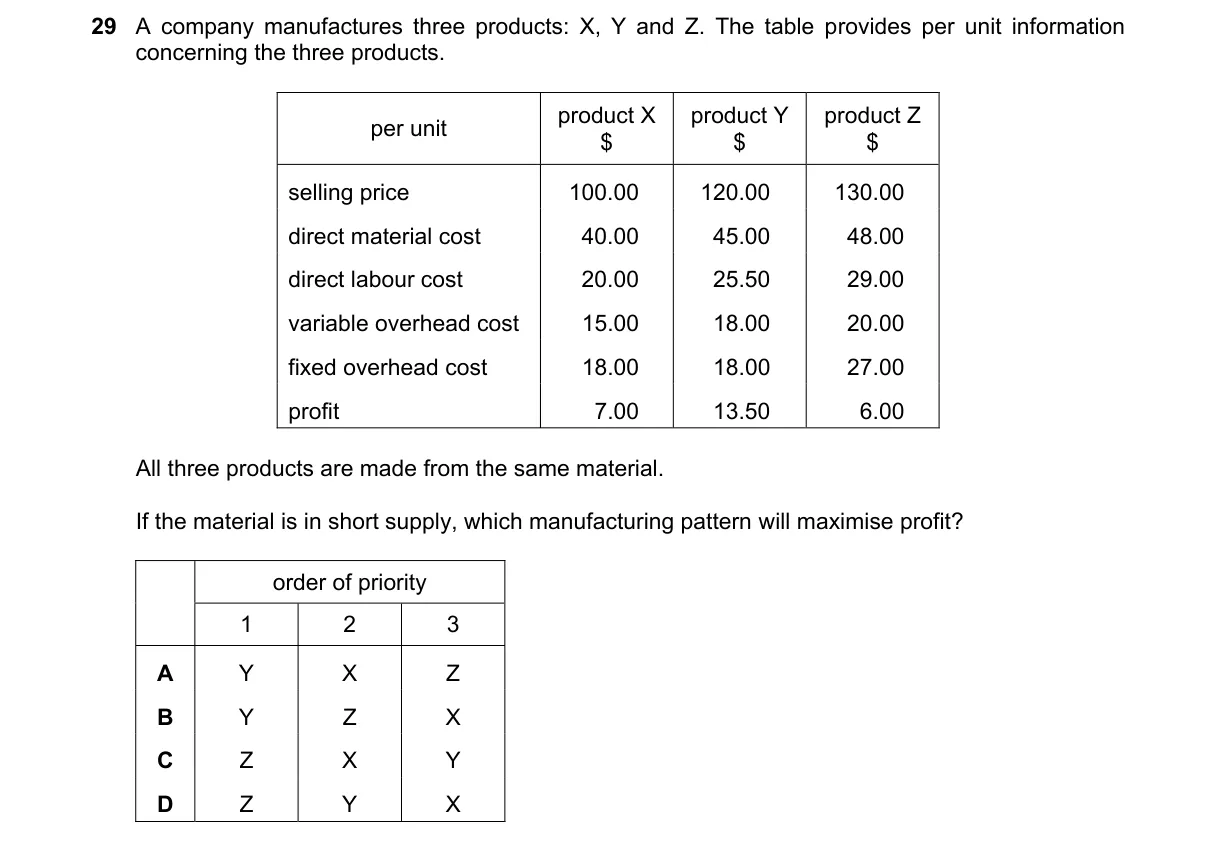
Answer choices
- AY X Z
- BZ Y X
- CX Y Z
- DZ X Y
Explanation
Rank by contribution per unit of scarce material
Steps:
- Compute contribution margin (CM = selling price - variable costs of material and labor): X (40 - 40), Y (45 - 50), Z (48 - 82).
- Divide CM by material cost (scarce resource): X (40 = 1), Y (45 ≈ 1.11), Z (48 ≈ 1.71).
- Rank products in descending order of CM per material dollar: Z (highest), Y, X (lowest).
- Produce in this order to maximize total contribution and profit.
Why B is correct:
- Option B (Z Y X) matches the ranking by CM per unit of limiting factor (material), per throughput accounting principle for constrained resources.
Why the others are wrong:
- A: Prioritizes Y over Z, but Z yields more CM per material dollar.
- C: Starts with X, which has the lowest CM per material dollar.
- D: Places X before Y after Z, but Y's ratio exceeds X's.
Final answer: B
Topic: Costs and cost behaviour
Practice more A Level Accounting (9706) questions on mMCQ.me