A Level Accounting (9706)•9706/11/M/J/23
A Level Accounting (9706) — 9706/11/M/J/23, Question 15
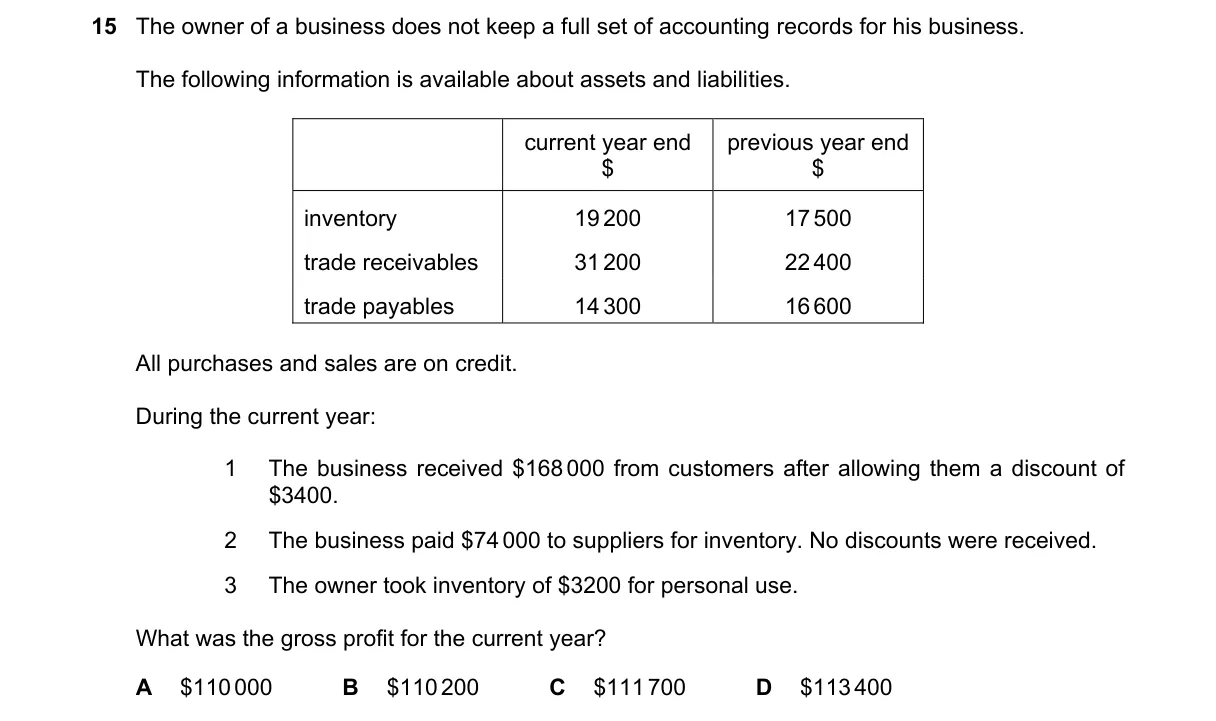
The owner of a business does not keep a full set of accounting records for his business. The following information is available about assets and liabilities. Inventory current year $19,200 previous year $17,500. Trade receivables 31,200 24,000. All purchases and sales are on credit. 14,300 16,600. During the current year: 1 $3,400 was received from customers after allowing them a discount of $16,000 from customers after allowing them a discount of. The business paid $47,000 to suppliers for inventory. No discounts were received. 2 The business took inventory of $2,000 for personal use. No discounts were received. 3 The owner took inventory of $2,000 for personal use. What was the gross profit for the current year?
Answer choices
- A$11,000
- B$10,200
- C$11,700
- D$11,400
Explanation
Gross profit from incomplete records Steps:
- Calculate credit sales: cash received from customers + discount allowed + (closing trade receivables - opening trade receivables). The sentence about cash received and discount is garbled, making exact figures unclear.
- Calculate credit purchases: cash paid to suppliers + (closing trade payables - opening trade payables) = 14,300 - 44,700.
- Calculate COGS: opening inventory + purchases - closing inventory = 44,700 - 43,000 (owner's inventory withdrawal implicitly included via reduced closing inventory).
- Gross profit = credit sales - COGS (requires clear cash/discount data for sales).
Not enough information to compute exact gross profit due to ambiguous cash received and discount details.
Final answer: Not enough information.
Topic: Preparation of financial statements
Practice more A Level Accounting (9706) questions on mMCQ.me