A Level Accounting (9706)•9706/12/M/J/21
A Level Accounting (9706) — 9706/12/M/J/21, Question 27
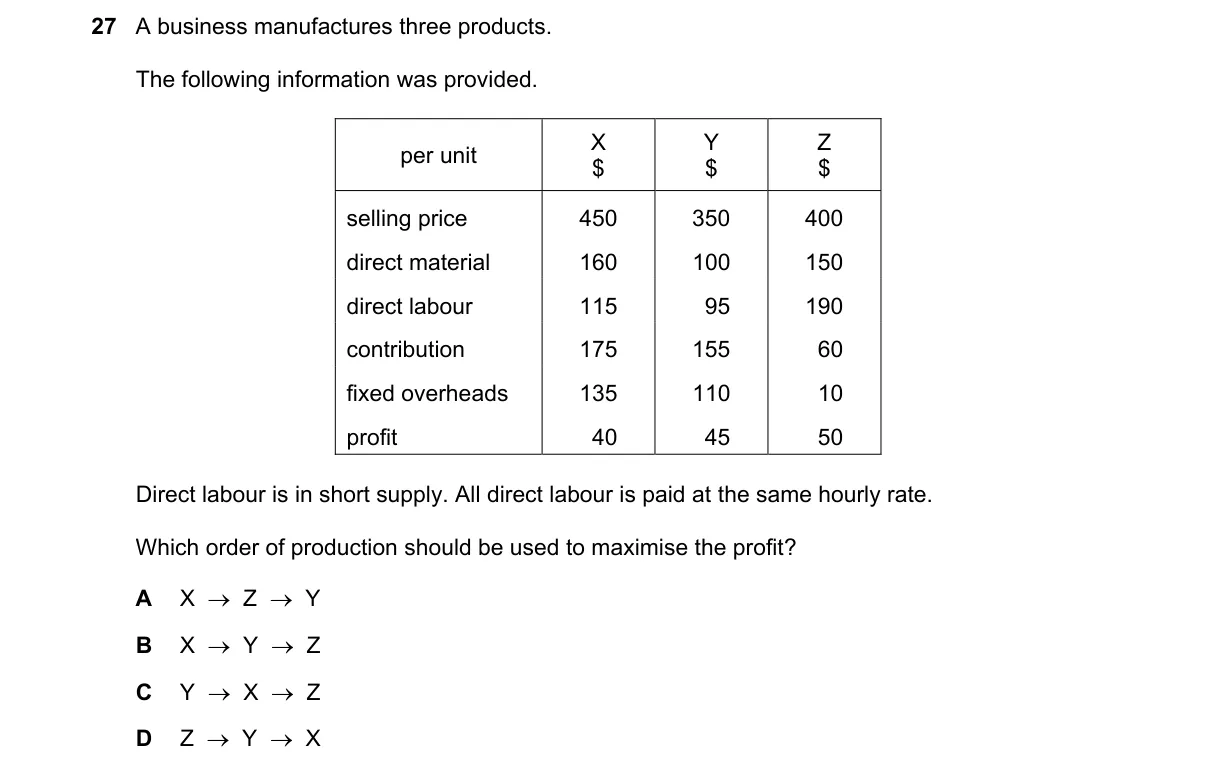
A business manufactures three products. The following information per unit is provided.
selling price | 450 | 350 | 400
direct material | 160 | 100 | 150
direct labour | 115 | 95 | 150
contribution | 175 | 155 | 60
fixed overheads | 135 | 115 | 50
Direct labour is in short supply. All direct labour is paid at the same hourly rate. Which order of production of X, Y, Z should be used to maximise the profit?
Answer choices
- AX → Z → Y
- BX → Y → Z
- CZ → Y → X
- DY → Z → X
Explanation
Rank by increasing fixed overheads per unit under labor constraint
Steps:
- Identify fixed overheads per unit: X = 135, Y = 115, Z = 50.
- Sort in increasing order: Z (50) < Y (115) < X (135).
- Prioritize production starting with lowest fixed overhead product to allocate scarce labor efficiently.
- This sequence balances overhead recovery while respecting labor limits.
Why C is correct:
- C (Z → Y → X) matches increasing fixed overheads order, maximizing profit via absorption costing where lower-burden products first minimize under-absorption expense (fixed overhead variance formula: actual fixed - absorbed fixed).
Why the others are wrong:
- A starts with high-fixed X, causing early under-absorption.
- B starts with high-fixed X, delaying low-burden recovery.
- D skips lowest-fixed Z, disrupting optimal cost sequence.
Final answer: C
Topic: Costs and cost behaviour
Practice more A Level Accounting (9706) questions on mMCQ.me