A Level Accounting (9706)•9706/11/M/J/20
A Level Accounting (9706) — 9706/11/M/J/20, Question 21
A company has been asked to prepare a quotation to print 100 leaflets for a customer. The total cost of direct materials, direct labour and a share of overheads is $20 and a profit of 25% on cost has been added. Which costing method is this an example of?
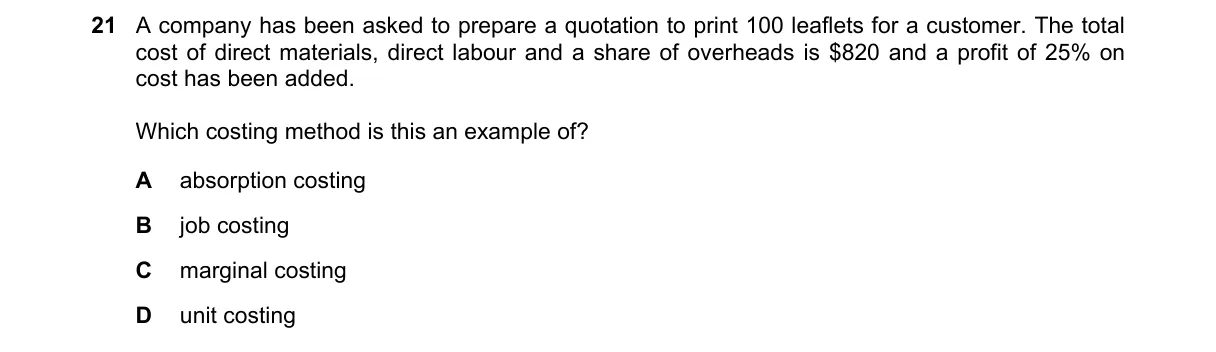
Answer choices
- Aabsorption costing
- Bjob costing
- Cmarginal costing
- Dunit costing
Explanation
Job Costing for Specific Custom Orders
Steps:
- Identify the scenario: preparing a quotation for a unique batch of 100 leaflets, a one-off customer order.
- Note costs included: direct materials, direct labor, and allocated overheads totaling $20, representing full job expenses.
- Observe profit calculation: 25% added on total cost, typical for quoting individual jobs.
- Match to definition: this tracks and accumulates all costs for a specific job, defining job costing.
Why B is correct:
- Job costing accumulates direct materials, labor, and overheads for individual custom jobs or batches, as in this printing quotation.
Why the others are wrong:
- A: Absorption costing includes fixed overheads in unit costs but applies broadly, not specifically to tracking unique jobs.
- C: Marginal costing uses only variable costs, ignoring overheads, unlike the inclusion of a share of overheads here.
- D: Unit costing calculates average costs for continuous, identical mass production, not discrete custom orders like leaflets.
Final answer: B
Topic: Traditional costing methods
Practice more A Level Accounting (9706) questions on mMCQ.me