A Level Accounting (9706)•9706/11/M/J/19
A Level Accounting (9706) — 9706/11/M/J/19, Question 29
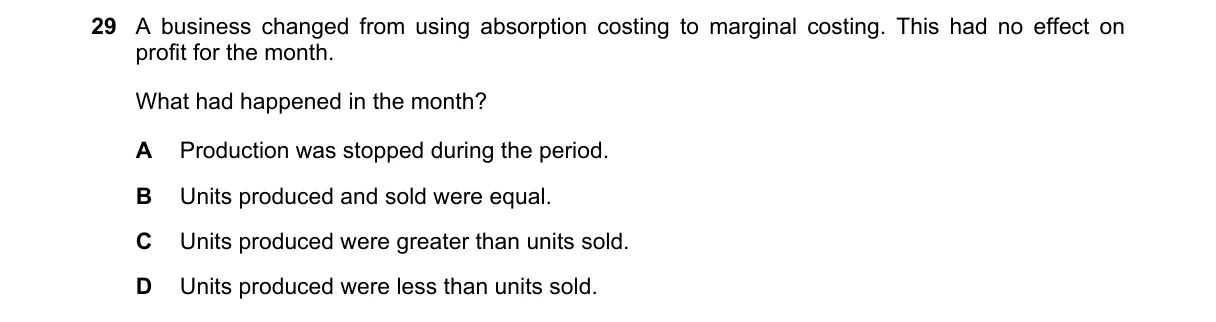
A business changed from using absorption costing to marginal costing. This had no effect on profit for the month. What happened in the month?
Answer choices
- AProduction was stopped during the period.
- BUnits produced and sold were equal.
- CUnits produced were greater than units sold.
- DUnits produced were less than units sold.
Explanation
Profit Equality in Costing Methods
Steps:
- Absorption costing allocates fixed manufacturing overheads to units produced, including them in inventory values.
- Marginal costing expenses all fixed overheads in the period incurred, excluding them from inventory.
- Profit differs between methods when inventory levels change, as absorption defers or releases fixed overheads via inventory.
- Equal profits occur only if production equals sales, leaving inventory unchanged and fixed overhead treatment identical.
Why B is correct:
- When units produced equal units sold, no inventory change occurs, so fixed overheads are fully expensed in both methods per the inventory valuation principle.
Why the others are wrong:
- A: Stopped production means zero units produced; if sales occurred, produced < sold, creating profit variance from inventory release.
- C: Produced > sold builds inventory, deferring fixed overheads in absorption costing and increasing its profit relative to marginal.
- D: Produced < sold reduces inventory, releasing fixed overheads in absorption costing and decreasing its profit relative to marginal.
Final answer: B
Topic: Traditional costing methods
Practice more A Level Accounting (9706) questions on mMCQ.me